In this Article
- Why Your First Upgrade Money Belongs to the Paddle
- What a Heavy Aluminum Package Paddle Asks of Your Arms
- Setting Length, Blade Area, and Shaft Flex Around Your Own Stroke
- When the Board Itself Has to Come First
- A Ranked Checklist That Puts Fit and Build Ahead of Material Names
- Running Your Own Side-by-Side Paddle Session
- Borrow a Better-Fitted Paddle Before Replacing a Sound Board
Why Your First Upgrade Money Belongs to the Paddle
Say your inflatable paddleboard feels steady under you, carries what you bring, and holds air from one outing to the next. In that case, I'd put your first upgrade budget toward a lighter paddle that fits you properly.
My reasoning comes down to what each piece of gear asks of your body. The board floats and carries you. The paddle is the thing you physically move, and you move it over and over. On every stroke you lift it, reach forward, plant the blade, pull it back, and lift it again to reposition. Across a relaxed morning on the water, that cycle repeats more times than anyone bothers to count, so small handling problems add up.
I also find it helps to stop asking which component matters more. Board suitability and paddle handling are two separate questions, and each deserves its own honest look. Start with the setup you already own: your current board and your complete, assembled paddle.
What a Heavy Aluminum Package Paddle Asks of Your Arms
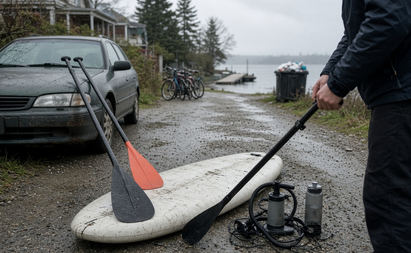
Many entry-level iSUP packages come with a heavy aluminum paddle in the bag. Some bundled paddles are perfectly decent, and I wouldn't lump them all together. Still, the heavy aluminum version makes a useful starting point, because almost everyone who has used one knows the feeling. Recovery feels slow and clunky, and you keep readjusting your grip to keep the blade where you want it.
Two separate things are going on. The first is total weight, meaning what the whole paddle weighs on a scale. The second is swing weight, which describes where that mass sits relative to your hands. When you rotate the paddle, mass that sits farther from your hands contributes more to rotational inertia. So a blade-heavy paddle can feel cumbersome every time you lift it, redirect it, or swing it across to the other side of the board, even if its scale weight looks reasonable.
The same principle explains why two paddles with similar total weights can handle so differently. The blade, shaft, grip, and connectors each carry part of the mass, and every design distributes it in its own way. It also explains why I treat a "carbon shaft" listing with caution. A carbon shaft tells you nothing about the weight or balance of the complete paddle, because the blade and adjustment hardware are still part of what you swing.
Here's what that means in practice. If your cruising rhythm feels awkward, break the package-paddle burden into four parts before you blame the board: assembled weight, blade-end balance, working length, and blade loading. Any one of the four can make a stable board feel like hard work.
Setting Length, Blade Area, and Shaft Flex Around Your Own Stroke
The goal is a stroke you can repeat comfortably for the whole outing. Maximum reach, the biggest blade, and the stiffest shaft don't serve that goal on their own. I work through fit in a fixed order: working length and adjustment first, then blade loading, then shaft response.
Working Length and the Top Grip
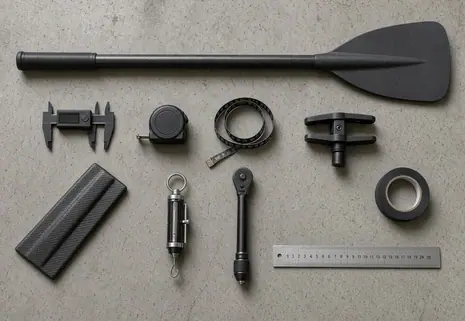
Treat a height-based chart as a starting point. Then check working length on your inflated board, standing in your normal paddling stance, on sheltered water. Watch whether you can bury the blade without exaggerated reaching or bending at the waist. If you're stretching to get the blade under, or hunching to keep it from diving too deep, adjust and try again.
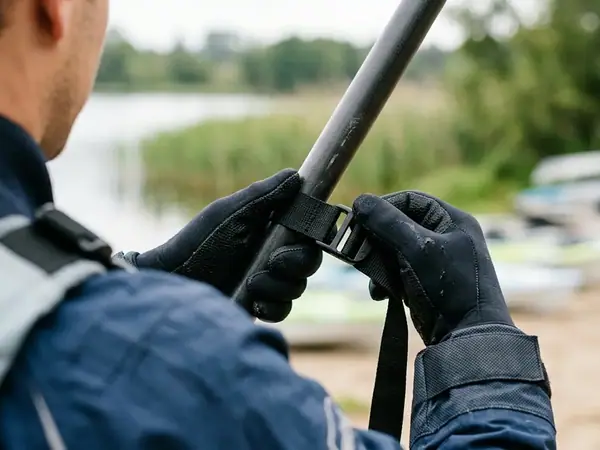
With your hand in its normal paddling position, notice how the top grip sits. It should feel natural without any squeezing. Then check that the adjustment mechanism holds the length you chose, with no slipping or twisting under load.
Blade Area and Your Cruising Rhythm
Compare blade area instead of blade length alone. At a similar stroke speed, a larger blade generally gives a heavier load on every pull. A smaller blade can suit a lighter, quicker rhythm, which many recreational paddlers find easier to sustain during ordinary cruising.
Shaft Stiffness Comes Last
A stiffer shaft yields less under load and can feel more immediate. A more flexible shaft gives a little during the pull. Neither response makes one shaft the better recreational choice by itself. Once length and blade size are sorted, use shaft feel as a tiebreaker.
When the Board Itself Has to Come First
How can you tell whether the board is the real problem? I start with three checks, because each one can make a good board feel wrong.
- Inflation: follow your board manufacturer's specified pressure guidance. Don't borrow a target from a friend's different model.
- Fin: confirm that it's installed and secured correctly.
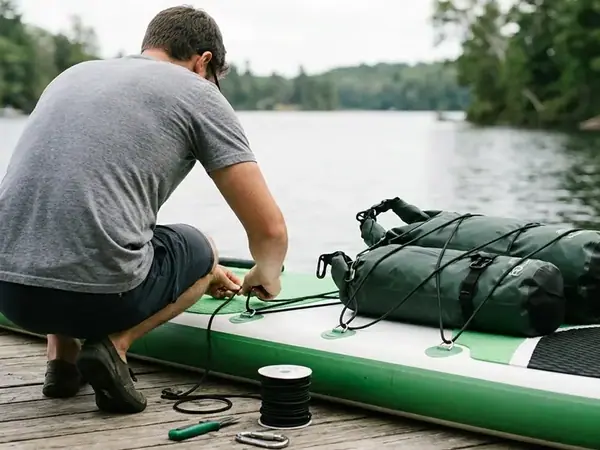
- Load placement: see where your gear sits and whether it's pulling the nose or tail down.
If the board still feels wrong after those checks, it's time to look at the board itself. In my view, board assessment or replacement takes priority in these situations:
- The board lacks enough stability for you, the paddler.
- It doesn't have enough capacity for the load you actually carry.
- Its shape doesn't suit the water or the use you have in mind.
- It has condition problems that need attention.
SUP fishing shows clearly where the line falls. Count everything you actually carry: yourself, tackle, a cooler, drinking water, and any other equipment. Then compare that total with the manufacturer's guidance rather than with your body weight alone. Tackle changes both the total load and how it's distributed. Shifting gear around can fix trim, but it can't raise the board's rated capacity. When a loaded angler finds the board sitting low or feeling unstable, capacity, stability, and condition matter more than any lighter paddle. Everything I've said about upgrading the paddle first assumes a sound board with enough stability and capacity for your real load, and a shape that suits your water. A functional mismatch comes first.
Stop Before Relaunching
If you suspect damage, notice a seam problem, or lose air you can't explain, stop and assess the board before your next outing.
That leaves the harder case: a board that works but that you've simply grown tired of. Wanting something newer is a reasonable feeling, and it's different from a mismatch. If the board passes the checks above and suits how you paddle, I'd put the paddle question first.
A Ranked Checklist That Puts Fit and Build Ahead of Material Names
When I compare paddles, I rank the criteria in this order. Assemble each paddle at your intended working length before you judge any of them.
- Usable adjustment range. Find the maximum-extension marking and the manufacturer's required shaft overlap. The range you can safely use may be shorter than the advertised one.
- Comfortable blade size for your cruising rhythm.
- Manageable swing weight when you lift and reposition the paddle.
- Secure joints. Hold either side of each connection and apply gentle opposing twist and push-pull pressure to check for play. Then confirm the length setting stays put.
- Grip comfort in your normal hand position.
- Transport suitability. Measure the longest packed piece against the actual inside of your luggage or board bag.
Carbon, composite, and aluminum are useful descriptions of how a paddle is built, so treat them as starting points. The assembled paddle's feel and construction tell you more than a premium-sounding label does.
Format comes down to travel convenience versus the number of joints. A conventional fixed-length, single-piece paddle has no adjustable shaft connection. A two-piece paddle has one, and a three-piece has two. Every connection is one more spot to inspect for movement. A three-piece paddle may pack smaller for SUP travel, but piece count alone won't tell you whether it fits your bag. Measure it.
Handle It Assembled
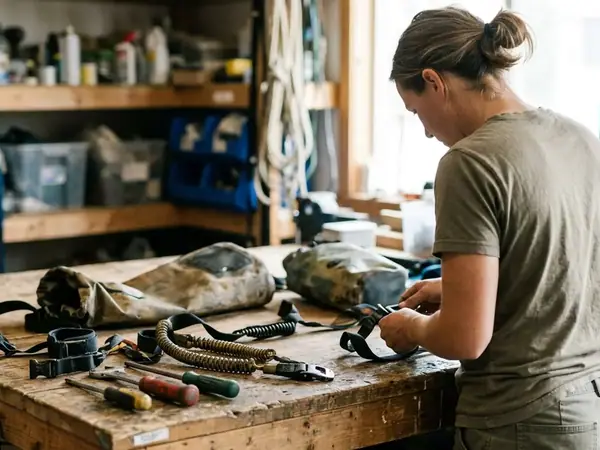
Assemble and adjust the paddle before you buy. That way you can judge grip shape, clamp access, and joint movement together, the way you'll actually use them.
Running Your Own Side-by-Side Paddle Session
Here's the comparison I'd suggest you run yourself. Use your current paddle and a borrowed, rented, or demonstrator alternative, both on your own board.
- Lock the board setup. Keep the board, carried load, fin setup, and gear placement the same for both paddles. Check inflation against the manufacturer's guidance before you start.
- Pick sheltered water that suits your ability. Mark out a familiar stretch between landmarks you can repeat. Don't mix an easy, sheltered leg with a noticeably windier or more exposed one.
- Fit each paddle on its own. Set each to a suitable working length. Matching the printed numbers won't necessarily give the same fit across different designs. Check every connection before you launch.
- Paddle the stretch with each one at an ordinary cruising pace. Where practical, run it again in reverse order.
- Write things down right away. Note recovery effort, grip pressure, blade entry, comfort, and whether you settled into a relaxed rhythm. Plain notes like "needed frequent grip changes" are more useful than any score you invent.
- Record visible differences as context. Blade shape, shaft material, and connector layout help explain your notes. They don't prove which paddle performs better.
Borrow a Better-Fitted Paddle Before Replacing a Sound Board
The decision rule is short. Keep a board that suits you and your load. Fix paddle fit and handling next. Replace the board when its condition or intended use calls for it.
Comfort Over Carbon
Choose the paddle you can swing comfortably, stroke after stroke, at a length that fits your stance. Repeatable comfort and proper fit will improve your paddling more than a prestige material ever will.
Before you buy a new board or a new paddle, book one session this week with a borrowed or demo paddle that's lighter and sized for you. Run it against your current paddle on the board you already own. Then let the notes you take on the water decide which purchase comes first.