In this Article
- Evaluating Equipment Fit Before Blaming Paddler Technique
- Deconstructing the Unsteady First Outing
- Auditing the Current Setup for Hidden Deficits
- Selecting a Comparison Candidate Based on Outline and Volume
- Structuring a Repeatable On-Water Handling Test
- Interpreting the Handling Record for Board Fit
- Addressing Persistent Instability After a Shape Change
- Executing a Methodical Gear Evaluation
Evaluating Equipment Fit Before Blaming Paddler Technique
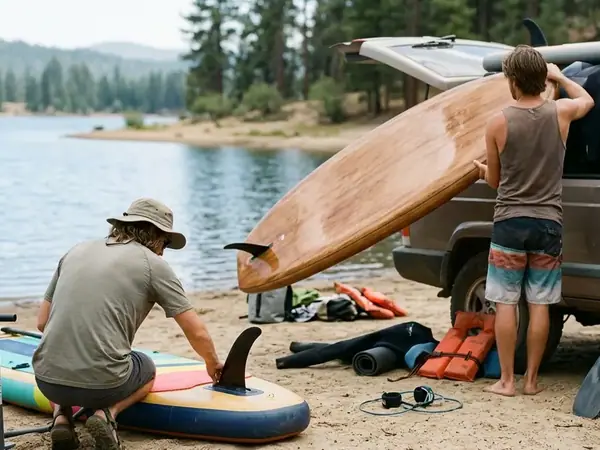
A beginner steps onto an inflatable paddleboard, feels an immediate, uncontrollable wobble, and retreats to the shoreline. That single moment dictates whether they will stand, make ordinary strokes, and return for another outing. We often rush to blame technique when a new paddler struggles to maintain equilibrium on the water. We assume the individual lacks inherent balance or core strength. The equipment deserves scrutiny before the beginner treats every wobble as a personal failure.
The transition from solid ground to a floating platform challenges the human vestibular system. When the platform is an inflatable paddleboard, the feedback loop between the water surface, the board's hull, and the paddler's feet becomes highly complex. A board that lacks the appropriate dimensions for the person standing on its deck will amplify every tiny weight shift into a major disruption of stability. Board dimensions need to match the load they carry.
Understanding the mechanics of stability requires looking past the paddler's initial frustration. If the equipment actively works against their center of gravity, no amount of verbal coaching from the shoreline will resolve the underlying mechanical mismatch. We must evaluate the physical platform before we critique the person standing upon it.
Deconstructing the Unsteady First Outing
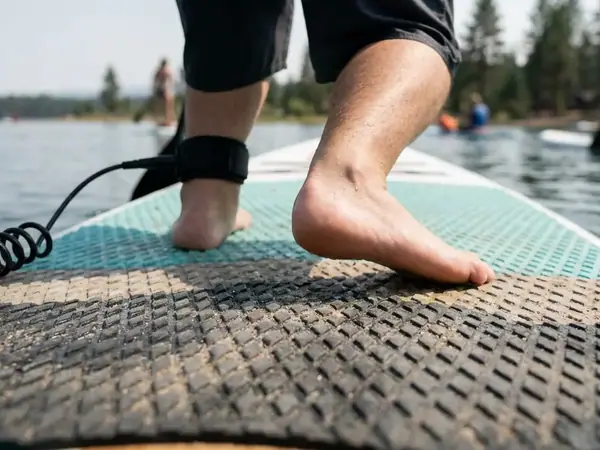
Picture a beginner attempting to stand on relatively calm water. The board shifts unpredictably beneath their feet, rolling from side to side with minimal provocation. The immediate physical reaction involves looking down at the deck pad, stiffening the knees, and making abrupt paddle corrections in the air. These physical responses add severe movement to an already unsteady stance. The paddler fights the board's natural roll, creating a pendulum effect that inevitably leads to a fall.
Is the board supporting the paddler and their load appropriately? Answering that requires isolating the variables. Record the water conditions, carried gear, inflation levels, and board dimensions entirely separately from observations of stance and paddle strokes. Break down the beginner’s ‘wobble’ into pressure, carried load, deck flex, cargo movement, fin setup, and foot position before crediting board width. Assuming technique is the sole culprit ignores the physics of a poorly matched vessel.
Stance Adjustment Observation: Looking down at the feet alters the paddler's center of gravity, pulling the head forward and initiating a forward pitch that the stiffened legs cannot absorb.
The environment plays a massive role in this initial perception of instability. Even on seemingly calm water, micro-currents and slight wind fetch create surface tension that interacts with the board's rails. A board with insufficient volume for the paddler will sit lower in the water, allowing these minor surface disruptions to wash over the deck and destabilize the stance. We must separate the paddler's physical reactions from the environmental and equipment baselines to understand the root cause of the instability.
Auditing the Current Setup for Hidden Deficits
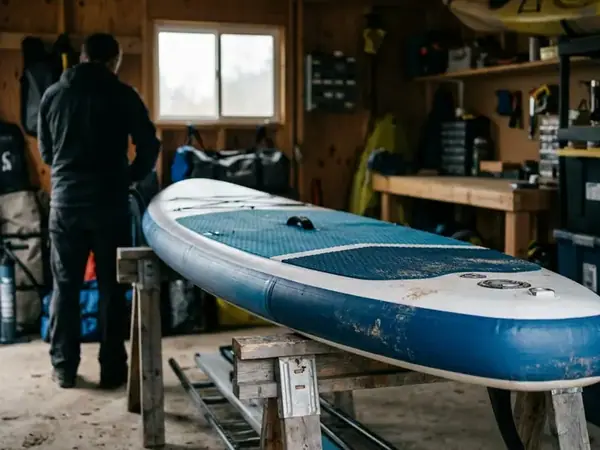
What mechanical factors mimic poor balance? Before proposing a new purchase, audit the existing setup. A board can sit well within its stated load limit yet still feel poorly suited to a beginner. The internal pressure dictates the rigidity of the drop-stitch core. Check the inflation against the manufacturer guidance using the pump’s pressure gauge. Under-inflated boards flex in the middle, creating an unstable, hammock-like effect under the paddler's weight. This flex absorbs the energy of paddle strokes and exaggerates side-to-side rolling.
Account for the paddler's body weight alongside all carried gear, including water bottles, dry bags, and anchors. Inspect the deck for unusual flex during weight transfers. Verify that cargo is tightly secured. Loose gear shifting on the deck alters the center of gravity unexpectedly, forcing the paddler to make sudden, reactive adjustments. Confirm the fin installation is correct, as a loose center fin severely degrades tracking and roll resistance.
Write down the stated width, length, thickness, volume, and load limit where the manufacturer provides them. Do not infer missing specifications. These shoreline checks help rule out mechanical deficits. A thorough audit often reveals that the board is simply under-inflated or improperly loaded, rather than inherently the wrong shape.
Setup Verification Takeaway: Use the pump’s pressure gauge to check inflation against that board’s specification. Manual squeeze tests fail to accurately measure the high PSI required for drop-stitch rigidity.
Selecting a Comparison Candidate Based on Outline and Volume
Proposing a swap requires a logical candidate based on geometry. Choose a wider inflatable board with a fuller outline and a broad standing area. This specific shape offers a plausible change in support during weight shifts. Compare its published specifications and intended load with the current board. Outline and width directly affect the standing platform. A board that carries its maximum width further toward the nose and tail provides a larger area of primary stability, resisting the initial rolling motion when the paddler shifts their weight.
Volume helps determine how the board carries its overall load, keeping the rails above the waterline. A wider shape generally feels steadier underfoot. It also tends to be less efficient to paddle over long distances, requiring more effort to push a blunt nose through the water. A narrower, pointed outline suits a completely different use case, prioritizing glide and speed over static balance. Stand on candidates before buying where a demo is available.
The relationship between width and volume dictates the board's hydrodynamic profile. A board can be wide but thin, resulting in low volume that fails to support a heavier paddler. Conversely, a narrow but thick board might have high volume but feel incredibly "tippy" due to its narrow footprint. The ideal beginner comparison candidate maximizes both width across the standing zone and sufficient volume to float the specific paddler high above the water surface.
Structuring a Repeatable On-Water Handling Test
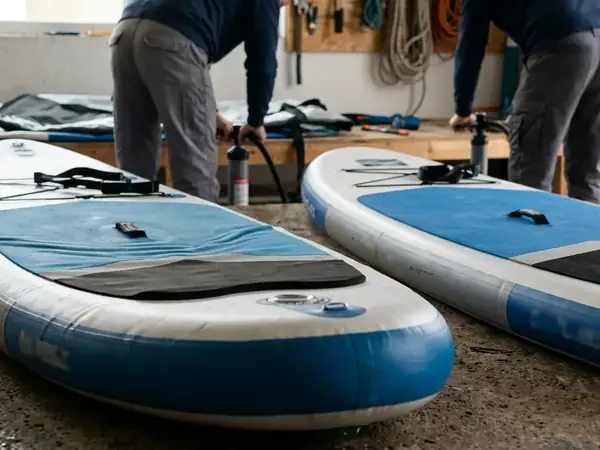
Arrange a sheltered-water comparison to isolate the board's influence. Use the same paddler, a similar gear load, and an observer on the shoreline. Inflate each board to its own specific manufacturer recommendation to ensure accurate baseline testing. Conduct this test in permitted water. Wear a personal flotation device and attach a leash appropriate to the setting.
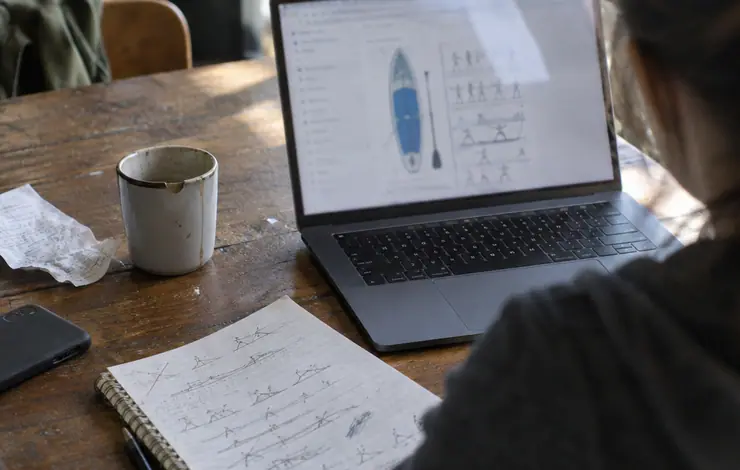
On each board, execute the exact same sequence. Mount the board. Stand up. Settle into a relaxed stance. Take straight strokes. Turn the board. Remount if needed. Record the standing time from reaching an upright stance until kneeling, sitting, or falling. The observer simultaneously records foot position on the standing area. Log any change in wind or chop. Treating consecutive outings as identical ignores the reality of shifting weather. A slight increase in wind fetch drastically alters the surface texture, invalidating a direct comparison.
| Board | Manufacturer specifications and load limit | Paddler and gear load | Inflation per board specification | Wind and water conditions | Standing time | Completed strokes | Falls | Remounts | Foot position and stance |
|---|---|---|---|---|---|---|---|---|---|
| Current Setup | Recorded from hull | Total weight in lbs/kg | Verified via gauge | Logged at launch | Measured in seconds | Counted per attempt | Total count | Total count | Observer notes |
| Comparison Candidate | Recorded from hull | Total weight in lbs/kg | Verified via gauge | Logged at launch | Measured in seconds | Counted per attempt | Total count | Total count | Observer notes |
The observer plays a critical role in this methodology. The paddler cannot accurately assess their own foot placement or posture while struggling for balance. The observer notes whether the feet are parallel, staggered, too far forward, or crowding the rails. This external data collection prevents subjective feelings of instability from clouding the mechanical reality of the board's performance under load.
Interpreting the Handling Record for Board Fit
What constitutes a meaningful improvement in stability? Compare the completed records before drawing a conclusion. A gain in standing time or completed strokes alongside a more relaxed stance supports a board-fit explanation under similar conditions. Calmer water or substantially different inflation levels leave that explanation uncertain. Compare standing time, completed strokes, falls, remounts, and the paddler’s description of stance comfort.
Willingness to continue serves as a useful qualitative observation. It does not replace the handling record. A paddler might feel more confident on a wider board simply due to its visual footprint, even if their actual standing time only marginally improves. We rely on the recorded metrics to validate the physical geometry of the board. Even a convincing result for this paddler would not establish the best width or shape for every beginner.
The interpretation phase requires strict adherence to the logged variables. If the comparison candidate yielded longer standing times, but the wind dropped from ten knots to zero between tests, the data is compromised. The goal is to isolate the board's outline and volume as the primary variables affecting the paddler's balance. When the environmental conditions and the paddler's load remain static, a significant increase in completed strokes points directly to a more suitable board fit.
Addressing Persistent Instability After a Shape Change
Sometimes a fuller board still feels unsteady. Revisit the paddler's stance and setup before considering yet another purchase. Check gaze direction, foot placement, and abrupt corrections. Beginners often place their feet too far back toward the tail or too close to the rails, negating the board's designed stability. Verify the pressure on the pump gauge, the carried load, secured cargo, and fin installation again. A skills lesson or a calmer practice area may address what a further shape change cannot.
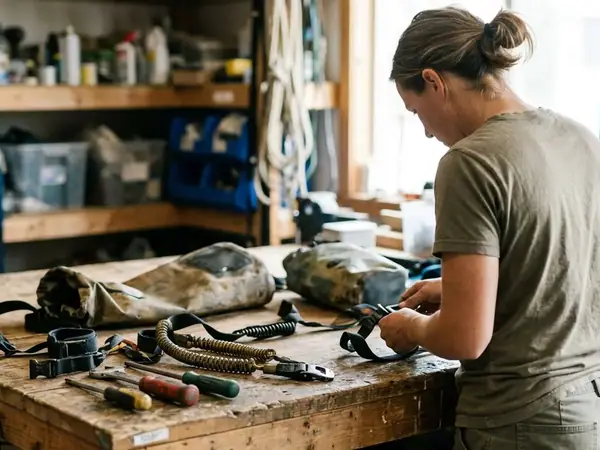
Log the wind, chop, and current at the time of the attempt. A sheltered-water gain on the fuller iSUP answers a board-fit question under the logged conditions, not whether that paddler is ready for wind, current or chop. Match the leash choice to the paddling setting rather than treating it as a universal accessory setup. A coiled leash suits flat water, while a straight leash is necessary for moving currents to prevent the board from rebounding into the paddler.
Sheltered Water Warning: A steady sheltered-water outing is not evidence of safety in stronger conditions. The comparison addresses beginner balance in its test conditions, not all-water safety.
Persistent instability on a wide, high-volume board usually indicates a fundamental biomechanical disconnect. The paddler may be locking their hips, preventing their lower body from absorbing the natural undulations of the water. In these instances, equipment changes yield diminishing returns. The focus must shift back to foundational skills—keeping the head up, maintaining a soft bend in the knees, and allowing the board to move independently of the upper body.
Executing a Methodical Gear Evaluation
Move systematically from setup verification to a specifications comparison, then to an on-water comparison. Bring the current board’s specifications and the paddler’s usual gear load to the evaluation. Keep both boards’ recorded conditions and results separate.
The process demands patience and a willingness to record data rather than relying on immediate emotional feedback. By isolating the variables of inflation, load, and environmental conditions, a paddler can accurately determine if their struggles stem from a lack of skill or a poorly fitted vessel. This methodical approach prevents unnecessary purchases and focuses attention on the actual mechanical deficits of the setup.
Arrange a sheltered-water demo of a wider, fuller inflatable SUP and record its handling beside the current board using the same test sequence.