Most beginners treat stance, stroke, and balance as three separate problems to solve. They aren't. They form a single control loop: where your feet sit changes how the board trims, where you plant the blade changes how it tracks, and where you look changes how fast you recover from a wobble. This guide teaches them as one connected sequence.
I'm writing for recreational paddlers in their first or early sessions, on calm lake, pond, marina, or protected bay water, using either an inflatable or hard SUP. If that's you, good. Technique will improve your control quickly.
It won't replace good judgment, though. When water turns cold, rough, crowded, or unfamiliar, technique alone isn't enough — flotation, conservative conditions, and hands-on instruction matter more than any cue I can give you here.
Choose Conditions That Let Technique Work
Here's the order that trips people up: they want to fix their balance before they fix their water. It should be the other way around. Beginner technique falls apart fast when the paddler is also fighting wind drift, boat wake, or a remount they haven't practiced.
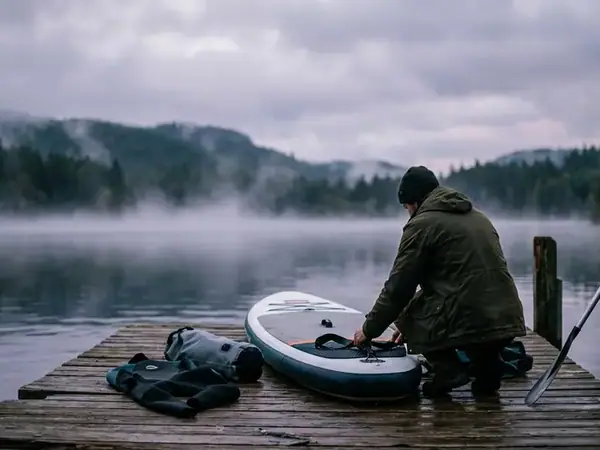
Practice on sheltered flatwater with enough room to paddle short straight lines and stop without drifting into docks, swimmers, anglers, moored boats, or shoreline plants. Before you launch, walk through a few checks.
- A shallow or gradual entry, with no sharp rocks directly underfoot.
- Clear space to fall beside the board.
- An uncluttered shoreline.
- A return path that is not directly upwind, so getting back doesn't become the hard part.
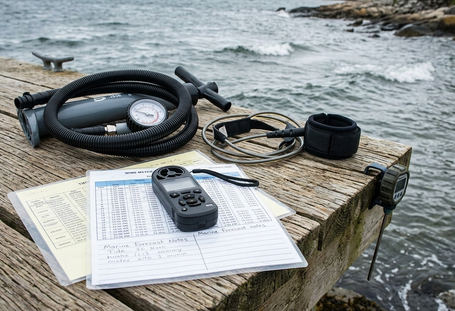
Risk Factor: Wear flotation appropriate to your water. The U.S. Coast Guard life jacket guidance is the practical starting point. Use a coiled leash for open flatwater, check the weather before you go, and don't paddle conditions you can't comfortably remount in. For current, rivers, tidal flow, or snag-heavy moving water, leash choice is a different conversation — this guide assumes calm, still water.
Set Your Stance Before You Stand Tall
Diagnose the Wobble: What Your Board Is Telling You
Most early instability begins at one specific moment: the change from kneeling to standing. So we slow that moment down and use the carry handle as your reference point.
The kneeling-to-standing sequence
- Start kneeling near the carry handle.
- Lay the paddle across the deck for light fingertip support.
- Place one foot at a time near the handle area.
- Pause in a low squat and let the board settle.
- Rise slowly.
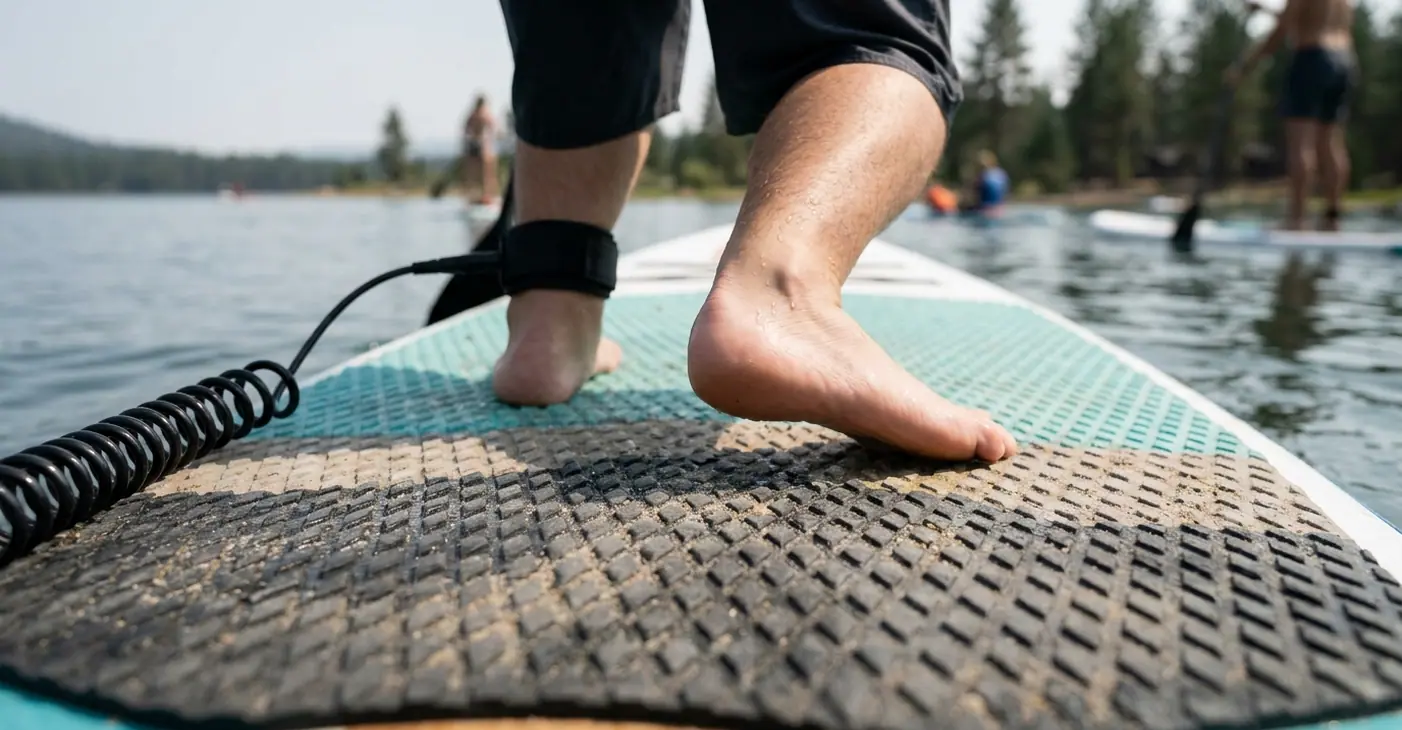
Once you're up, check your landmarks. Feet roughly shoulder-width. Toes pointed forward or slightly open. Weight centered over the carry handle. Knees soft, hips stacked over your feet. Tall spine, relaxed shoulders, eyes on the horizon or a fixed shoreline object rather than down on the deck pad.
Trim is the part beginners rarely connect to their feet. Stand too far back and the nose lifts, making the board feel sluggish and slow to track. Stand too far forward and you bury the nose, which makes the board feel sticky, like it's plowing.
A paddler who stands several inches behind the handle often blames the stroke for poor tracking. The real culprit is tail-heavy trim lifting the nose.
Recommendation: If the board rolls side to side, widen your stance slightly and bend your knees before you add any paddle speed.
Build a Forward Stroke That Moves the Board, Not Your Body
Break the forward stroke into four parts — catch, power, exit, recovery, so you can name which part is causing yaw or wobble. We're not chasing speed here. We're chasing quiet blade placement.
Catch
Place the full blade in the water near the nose-side area before you pull. Don't slap the surface, and don't start pulling with only half the blade buried. A clean catch is the difference between pulling water and pushing air.
Power
Keep the shaft close to vertical, with your top hand stacked over your lower hand and the blade traveling near the rail. That vertical, close-to-the-rail path is what reduces yaw and keeps the board tracking straighter. Rotate through your torso and brace through your core rather than yanking with the lower arm.
Exit
Remove the blade near your feet. Dragging it well behind your stance line feels powerful, but the board is actually turning and bleeding speed. A paddler who exits late often thinks they're making a stronger stroke while doing the opposite.
Recovery and switching
Count a few clean strokes on one side, then switch before the nose swings far off line. For many beginners, sets of three to five strokes per side is the easiest rhythm to learn.
Practice Balance With Drills That Stay Close to Shore
Fatigue makes stance sloppy and paddle placement rushed. So balance practice should feel like controlled resets rather than continuous paddling. Stay close to shore and alternate movement with stillness. Work through these three drills in order.
1. Quiet stance hold
Stand still. Soften your knees. Breathe normally. Look at one fixed shoreline object until the board settles underfoot. The goal is to feel the board settle rather than fighting every ripple it sends up.
2. Slow paddle taps
Place the blade lightly on one side, then the other. You're using the paddle as a balance reference, not a crutch — the point is to learn bracing without leaning your weight hard onto it.
3. Glide-and-pause
Paddle three to five smooth strokes, stop, breathe, and let the board coast while you hold tall posture. Then repeat.
Critical Insight: Work in short repetitions of five to eight minutes, reset often, and end the session before tired legs start producing sloppy stance and rushed strokes.
By now you have the pieces. This section is for reading the feedback. Each common error starts with what you feel on the water, names the likely cause, and points back to a stance, stroke, or balance fix you already know.
| What you feel | Likely cause | Fix |
|---|---|---|
| Board zigzags after nearly every stroke | Blade is too far from the rail, exit is too late, or top hand crosses the centerline | Use a more vertical shaft, exit near the feet, switch sides sooner |
| Legs shake | Locked knees, gripping with the toes, tense ankles, or staring down at the board | Soften the knees, relax the feet, gaze at the horizon, slow your breathing |
| Board feels slow and unstable | Standing forward or aft of the carry handle, or gear loaded unevenly on the deck | Recenter your stance and simplify the deck load |
| Falling during turns | Twisting the shoulders while standing tall, or stepping before balance is set | Lower the stance, plant the paddle first, then rotate |
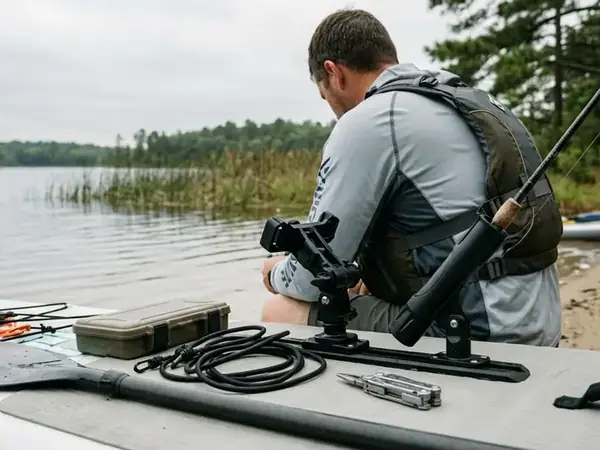
That third row catches a lot of paddlers off guard. A board can feel unstable in calm water simply because a dry bag, small cooler, anchor, or fishing crate sits forward or aft instead of centered. Before you blame your balance, check your load.
Where This Beginner Technique Advice Stops
Let me draw a clean line. Everything above is for calm recreational flatwater practice. It is not for whitewater, surf zones, offshore crossings, racing, downwinders, or cold-water expedition paddling. Those demand different skills and different judgment than a sequence guide can responsibly cover.
Seek hands-on instruction if you repeatedly fall in calm water, can't remount reliably, plan to paddle in current, paddle in cold seasons, or struggle to control the board near other water users. None of that is failure — it's just the point where in-person coaching beats reading.
For your next session, keep it simple: choose sheltered water, rehearse the kneeling-to-standing move near shore, paddle short straight lines, pause often, and stop while your control still feels clean. Ending a session early, while technique holds, teaches your body more than grinding through wobble ever will.