In this Article
- Two Pressure Numbers, Two Different Meanings
- Maximum PSI Is a Limit, Not a Performance Score
- Where Inflation Pressure Actually Changes the Ride
- What More Air Cannot Fix
- Use a Field Check Instead of Chasing the Gauge
- Pressure Management Does Not End at Launch
- Choose a Baseline the Board Can Repeat
Two Pressure Numbers, Two Different Meanings
Open the instruction sheet that came with almost any inflatable paddleboard and you will usually find two pressure figures, not one. There is a recommended operating range, and there is a maximum limit.
These serve different jobs. The operating range guides your normal setup: it is where the maker expects the board to perform as designed. The maximum limit is a boundary, the point you are told not to cross, and it works more like a fence than a finish line.
Read the board-specific instructions as written and you will actually meet three numbers rather than two. There is the maker's recommended range, the maker's maximum, and the reading your own gauge shows once you stop pumping. Keeping those three separate in your head is the whole game.
Maximum PSI Is a Limit, Not a Performance Score
A common habit among paddlers comparing boards is to line up the maximum PSI figures and rank them, as if a higher ceiling meant a better board. That comparison does not hold.
Board geometry, internal construction, dimensions, intended load, and the manufacturer's own instructions all differ from one model to the next. A maximum rating tells you what a specific board can tolerate given its specific build. It says nothing standardized about quality that would let you place two different boards on the same scale.
It helps to treat pressure as a threshold variable. Below a certain firmness the board flexes, sits poorly under load, and responds slowly to the paddle. Once the loaded board is adequately rigid within its stated operating range, pushing closer to the maximum does not buy you a proportionate improvement. The board is already firm; more air past that point mostly adds risk, not glide.
A useful setup record reflects this. Keep separate entries for the recommended range, the maximum limit, and the gauge reading you actually achieved, rather than a single field labelled "PSI." And if the pump stops sealing, the hose leaks at the fitting, or the needle refuses to settle, fix the connection before you trust the number on the dial — practitioner reports from repair benches point the same way.
Where the Ceiling Misleads
The same board and gauge reading can feel settled with one paddler on flat water, then trim poorly the moment you add a passenger, a dog, a cooler, or a stern-loaded fishing crate. That variation does not turn the maximum rating into a useful cross-board score. It simply confirms that load and placement move the ride more than the last half-PSI ever will.
Where Inflation Pressure Actually Changes the Ride
Meaningful underinflation announces itself. You feel greater flex under load, the platform stops feeling settled beneath your feet, paddle input produces a delayed or mushy response, and the board struggles to hold the shape it was built to hold.
Watch for this during the first few minutes afloat rather than during a press test on shore. In those opening three to five minutes, look for the standing area sinking noticeably under your usual load, pronounced bending between nose and tail, or a lag when you apply a stroke.
Certain situations raise the stakes for adequate rigidity:
- A heavier combined payload of paddler plus cargo
- Fishing equipment carried aboard
- A passenger or a dog
- Longer boards that carry more load between the ends
- Unsettled water, chop, or wind
The correct response is not to sprint toward the maximum. First confirm that the total load suits the board and that your inflation already sits inside the recommended range. Then repeat the observation with dry bags and gear secured in their normal positions, because an empty shoreline test never reproduces the forces a paddler and concentrated cargo create.
What More Air Cannot Fix
Plenty of handling problems get blamed on pressure when the real cause sits elsewhere. Four variables tend to matter more, and it pays to check them in order: board fit, payload placement, environmental conditions, and paddling setup.
Board Fit
Length, width, outline, volume, and intended use shape stability and glide largely independently of pressure. A narrow touring board asked to serve as a fishing platform will feel tippy at any legal PSI. No amount of air changes the outline you bought.
Payload
Exceed the board's intended load, or concentrate a heavy fishing setup near one end, and you get poor handling that pressure cannot rescue. A board can show an acceptable gauge reading and still flex or wander because the load is unsuitable or piled toward the bow or stern.
Conditions and Setup
Diagnose a poor ride in a fixed sequence and you avoid masking a real fault with an air adjustment:
- Excessive flex — check the board-specific pressure range and the total load.
- Poor tracking, check fin seating, fore-aft trim, and stroke path.
- Instability, check board width and outline, stance, cargo position, and wind or chop.
Before touching pressure, confirm the fin is fully seated and retained, that cargo cannot slide during turns, that you are not standing unusually far forward or aft, and that your paddle length allows a controlled vertical stroke.
Diagnose Before You Inflate
These priorities suit ordinary recreational touring, casual sup fishing, and general-use paddling. Racing, whitewater, and surf competition run their own equipment-specific tuning practices, so treat this order as a recreational baseline rather than a universal rule.
Use a Field Check Instead of Chasing the Gauge
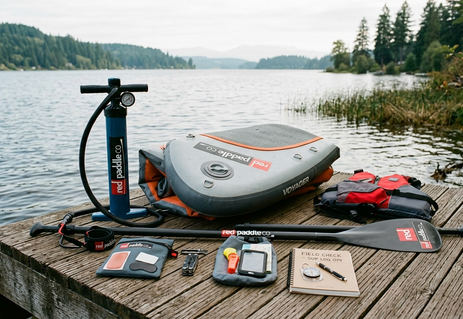
A repeatable pre-launch routine beats staring at a dial. Run the same sequence every time:
- Consult the current board-specific instructions.
- Inspect the valve and visible seams for damage or movement.
- Attach the correct pump fitting and confirm it seals.
- Inflate within the recommended range.
- Confirm the gauge reading, then set the pump aside.
Load the board the way you will actually use it. Distribute dry bags, fishing equipment, and other cargo securely in their normal positions instead of testing an empty deck. A bare board tells you little about how the loaded one will behave.
At the shoreline, before you head into deeper water, assess rigidity, trim, fin installation, and any obvious flex. Then judge stability, tracking, and response over several normal forward strokes during those first three to five minutes afloat. Do not release air or reconnect a pump while drifting in deep water.
After a satisfying outing, write down four baseline details: the gauge reading, your usual payload and its placement, the fin setup, and the water state — flat, light chop, or wind-affected. That short record turns a good day into a repeatable one.
Pressure Management Does Not End at Launch
Internal pressure moves as the board and the air sealed inside it warm or cool. A reading you set in a cool morning can climb as the sun works on the deck.
So separate launch inflation from heat management. Once you have the correct launch pressure, think about where the board will sit during transport and shore breaks. Leaving a fully inflated board on hot sand, on pavement, on a vehicle roof, or inside a closed car invites trouble the printed maximum was never meant to cover. That maximum is not a heat allowance stacked on top of the recommended range.
Move the board into shade during long breaks, monitor it rather than treating it as unattended gear, and follow the maker's instructions for managing pressure across the day.
Stop-Use Signals
Hissing at a seam, recurring pressure loss, valve movement, bubbling during an approved leak check, or a visible structural distortion is a stop-use condition. Do not compensate by adding air. Follow the maker's inspection and repair guidance instead.

Choose a Baseline the Board Can Repeat
The decision hierarchy is simple to hold in mind. Obey the board-specific limits first. Establish adequate rigidity under your usual load second. Then work through board fit, cargo position, conditions, and technique.
Pressure matters most when it is clearly too low, outside the printed instructions, or poorly managed as temperature and storage change through the day. In the broad middle of the recommended range, consistency serves you better than winning a contest over the highest gauge reading.
For your next launch, do this: pick one target inside the board's recommended range, set up the usual fin and cargo arrangement, and hold that exact baseline through the initial three-to-five-minute ride check. If the ride still disappoints while pressure sits in range, change one non-pressure variable — cargo position, stance, or fin installation, note what you changed, and carry that record to the following outing.