In this Article
- The Single-Bag Adriatic Constraint
- Ferry Transfers Dictate the Load
- Packing the Soft Core
- Terminal to Water Logistics
- Omissions on the Water
- Refining the Transit Order
- The Final Verdict on Cabin Baggage
The Single-Bag Adriatic Constraint
A complete inflatable paddleboard setup crossed the Croatian coastline inside a single carry-on bag. No checked luggage accompanied the paddler on this multi-island journey. The closed-bag chain from the initial airport arrival through ferry racks, island foot carries, saltwater launches, and wet-kit repacks sets a rigorous baseline for evaluating travel gear.
The practical question centers on endurance and accessibility. A working iSUP travel system must remain compact through flights, ferry transfers, walks to launch points, and repeated repacking. The airline flight was only one hurdle in the complete handling chain. The bag also had to handle ferry transfers, transport to the water, on-water equipment gaps, and the revised second-pack system.
Every component faced strict scrutiny before departure. The deflated board, paddle, pump, and safety gear had to fit within the airline sizer and meet the baggage-scale limit. The resulting kit stripped away redundancies and forced a reliance on core functionality.
Ferry Transfers Dictate the Load
The decision to skip checked baggage stemmed directly from the itinerary. Moving between Croatian islands requires constant gear handling. The route involved a specific arrival point, a sequence of islands, multiple ferry legs, and frequent accommodation changes. Repeated handling occurred well beyond the airport terminal.
The closed bag had to remain manageable during ferry boarding, disembarkation, and movement to launch sites. A bulky checked board bag becomes a severe liability when navigating crowded terminal walkways or securing a spot on a passenger luggage rack. The transport constraint forced every item to earn its place.
The packing edit followed a fixed hierarchy. Retain personal-safety equipment first. Prioritize board-operation components second. Keep repair capability third. Relegate clothing or comfort items to the bottom of the list. Transfer frequency and terminal walks dictated both the no-checked-bag decision and the load.
A heavy bag slows down terminal transfers and increases physical fatigue before the paddling even begins. The single carry-on approach eliminated the wait at baggage claim and streamlined the transition from air travel to maritime transit. The paddler maintained constant control over the equipment.
Packing the Soft Core
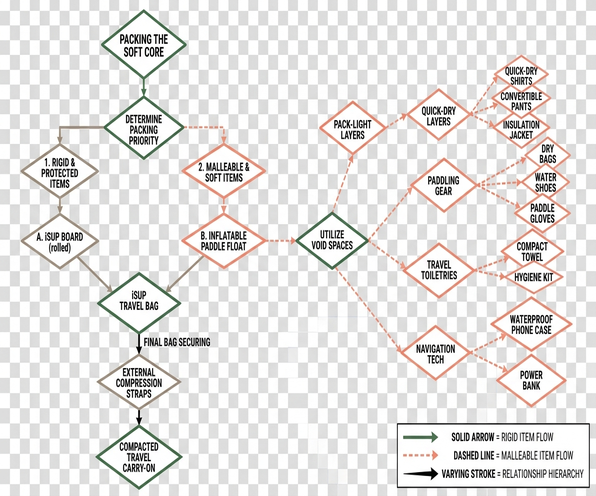
How do you fit a functional watercraft into an airline-compliant space? Packing organizes around function rather than conventional luggage compartments. The deflated board forms the soft core of the load.
Rigid paddle sections and the fin system sit strategically where their ends cannot rub directly against the board skin. The pump occupies the remaining long cavity. Repair materials, travel documents, electronics, and verified safety equipment fill the protected gaps. Clothing and comfort items take the lowest priority.
Home validation involves a strict sequence. Complete the final fold. Leave the board packed as it would travel. Unpack it to inspect high-pressure fold lines and confirm valve clearance. Inflate the board to confirm the pump fitting. Rebuild the same closed-bag layout. This Croatian carry-on result does not define a safe kit for exposed crossings, different seasonal conditions, another airline or ferry operator, a larger board, a different paddler, or launches governed by separate local restrictions.
Home-carried, rented, borrowed, and locally purchased equipment must be identified separately. The carry-on manifest cannot claim equipment obtained after arrival. The baseline manifest included the deflated iSUP, valve cap, fin, attachment hardware, sectional paddle, pump, hose, valve adapter, repair materials, and personal-safety equipment.
Packing Priority: Hull Protection
Isolate the paddle blade and shaft ends from the folded PVC. Constant vibration during transit causes rigid edges to wear through the board material. Wrap the fin and hardware in a soft layer and position them near the top opening for immediate access upon arrival.
Terminal to Water Logistics
On a typical transfer day, the paddler leaves the accommodation and walks to the ferry terminal. Keeping all board components inside one closed bag reduces the number of pieces that could be left behind during a rushed boarding sequence.
Storage aboard usually means finding space on a shared passenger luggage rack. After disembarking, the walk to the launch site tests the pack's balance and suspension. Unpacking, assembling the paddle and fin, and inflating the board follow a strict order. Securing the empty travel bag while on the water requires planning.
The entire process relies on the gear remaining consolidated. Formal baggage policy and observed staff practice require separate entries. One describes the dated rule. The other records what happened on that specific sailing. The paddler navigated the terminal, boarded the vessel, and stowed the bag without requiring assistance or paying oversized cargo fees.
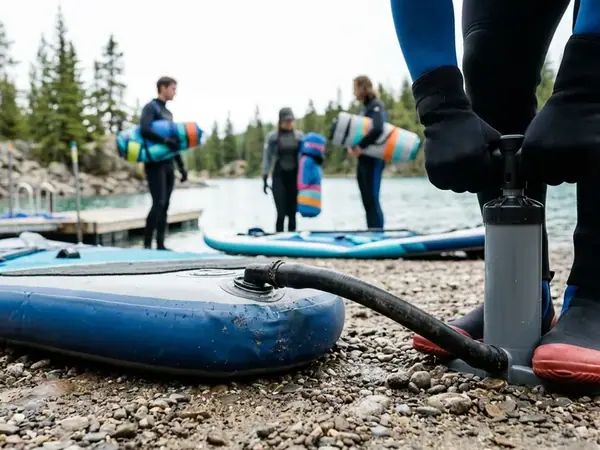
The transition from the ferry terminal to the water demands efficiency. The paddler unrolls the board, attaches the fin, assembles the paddle, and connects the pump. Inflation takes physical effort, serving as a warm-up before hitting the water. The empty bag, now stripped of its rigid core, rolls up and secures under the board's bungee cords.
Omissions on the Water
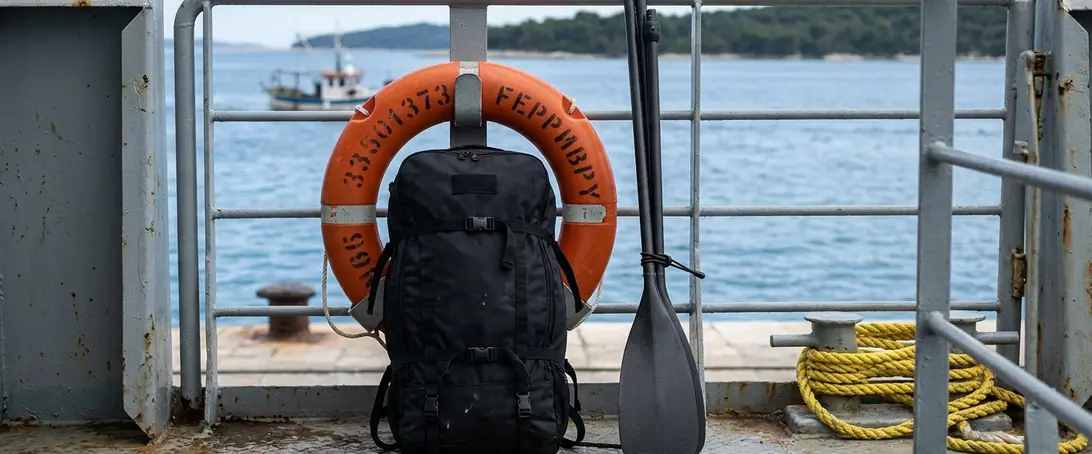
The safety-kit-before-comfort threshold for deciding whether this Adriatic island load remains cabin baggage or moves into a checked board bag forces compromises. Every gear gap traces back to a specific packing decision.
A missing comfort item might cause a delay or discomfort. Omitting flotation, signaling gear, or board retention equipment reduces safety capability. When a launch situation exposes an absence, the paddler must rely on a workaround, a local purchase, or a decision to continue without it.
Relying on a local purchase requires confirming stock and opening hours. A local purchase requires the receipt description and paid amount. An improvised substitute requires a precise firsthand description of the materials used. Gear-gap records distinguish discomfort from reduced safety capability instead of combining both under a generic forgotten-accessories list.
The absence of a dedicated dry bag forced the paddler to leave electronics on shore during certain launches. The omission of a heavy-duty leash string required careful inspection of the existing attachment point before tackling choppy conditions. These gaps highlight the friction between mobility and comprehensive preparedness.
Evaluating Local Substitutes
Never rely on island shops for critical safety gear or proprietary board hardware. Local stores stock general beach supplies, not specialized iSUP replacement parts. Pack your own valve wrench, patch kit, and fin screws before leaving home.
Refining the Transit Order
What changes after the initial island circuit? The second-pack system reconciles the departure manifest with the transfer log and gear-gap record. Each object receives one action. Retain, add, remove, replace with a smaller equivalent, or relocate for faster access.
Safety and board-operation components stay protected inside the main load. Items needed before inflation or immediately after landing move near the opening. Transit-only gear shifts to exterior pockets. The revised order protects critical equipment from both baggage handling and repeated ferry-terminal repacking.
A closed-bag carry rehearsal includes stairs, a standing wait, and enough continuous walking to expose pressure points before departure. The revision log shows the original position and revised position of relocated items. The pump hose, initially packed deep in the bag, moved to the top compartment to prevent crushing and allow faster setup.
The revised system acknowledges the reality of wet repacks. A damp board requires careful folding to avoid trapping moisture against the valve. The paddle sections need a quick freshwater rinse before sliding back into the bag to prevent salt buildup from jamming the adjustment mechanism.
The Accessibility Shift
Move transit documents, ferry tickets, and immediate-need items to exterior pockets. Digging through a packed board bag on a crowded dock exposes the internal gear to the elements and slows down the boarding process.
The Final Verdict on Cabin Baggage
The compact trip ledger shows more than the novelty of fitting a board into cabin baggage. Mobility gains include one closed load and fewer loose components during ferry changes. Costs include reduced redundancy, little room for comfort equipment, and strict dependence on the exact baggage rule attached to each booking.
Comparing the original and revised systems highlights the value of the minimalist approach. The physical toll of carrying a massive checked bag across cobblestone streets negates the benefit of having extra gear on the water. The single-bag system forces a disciplined evaluation of what truly matters for a successful launch.
Commit entirely to the single-bag system for multi-leg coastal routes. The mobility advantage during constant transit outweighs the comfort of a fully loaded checked bag. Pack the essential board components, secure the safety gear, and leave the redundant accessories at home.