In this Article
The Short Version Before You Pack
Flying with an inflatable paddleboard is usually a checked-bag problem, not a carry-on problem. Attempting to compress a board, pump, and paddle into an overhead bin rarely works in practice. Planning for a checked bag immediately simplifies the packing process.
Plan for the deflated inflatable SUP, the travel bag, a three-piece paddle, a removable fin, a leash, a manual or electric pump, valve wrenches, repair-kit items, a dry bag, a personal flotation device (PFD), and small safety accessories. You need to have the packed bag ready for conveyor belts, vertical stacking, cart transfers, and possible hand inspection rather than only fitting neatly in a home closet.
Key point: Confirm current airline size and weight limits first. Then pack hard items away from the board skin, valve, fin box, and rail seams.
Set your expectations early. Airline baggage rules change frequently based on the carrier, specific route, fare class, and aircraft size. What flies free on a wide-body international flight might incur heavy oversize fees on a regional jet.
Confirm the Airline Rules Before the Board Leaves Home
In my experience tracking global travel standards, a board bag often fits the airline's published weight limit when only the board is inside, but exceeds the allowance after the pump, paddle shafts, fin, leash, repair pouch, water shoes, and clothing padding are added. This forces travelers into frantic repacking at the check-in counter.
You must check the airline's current checked-bag dimensions, weight allowance, oversize fee language, and sports-equipment page 24 to 72 hours before departure. Measure the packed bag as length plus width plus height. Many airline baggage pages describe size by combined linear dimensions rather than by board length alone. Weigh the bag on a bathroom scale after adding all your gear. Do not rely on the board's advertised bare weight.
If the packed bag is close to the allowance, remove dense extras first. Pull out repair tools, water shoes, fishing tackle, heavy pump hoses, or spare clothing and move them to your carry-on or standard luggage. Finally, save a screenshot or PDF of the airline policy page with the date visible before leaving for the airport. Gate agents sometimes need a polite reminder of their own sports equipment policies.
Prep the Inflatable Board So It Travels Flat, Dry, and Protected
Why does a thorough cleaning matter before a flight? Grit, salt, and trapped water create avoidable problems once the board is sealed inside a dark, unventilated travel bag for hours or days. Moisture adds unnecessary weight, encourages odor, and makes the bag messier during a security inspection.
Use a clean-to-roll sequence. Rinse salt, sand, and grit from the deck pad, rails, fin box, D-rings, handle mounts, and valve area. Give the deck pad and seam areas a real drying window of 45 to 90 minutes in moving air when conditions allow. Shaded airflow is better than a hot surface that bakes moisture into folds.
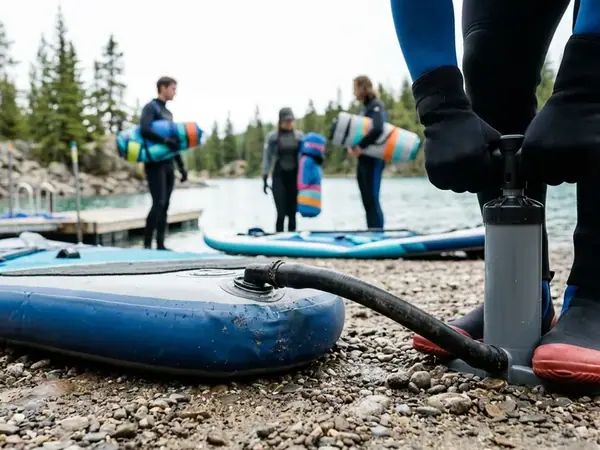
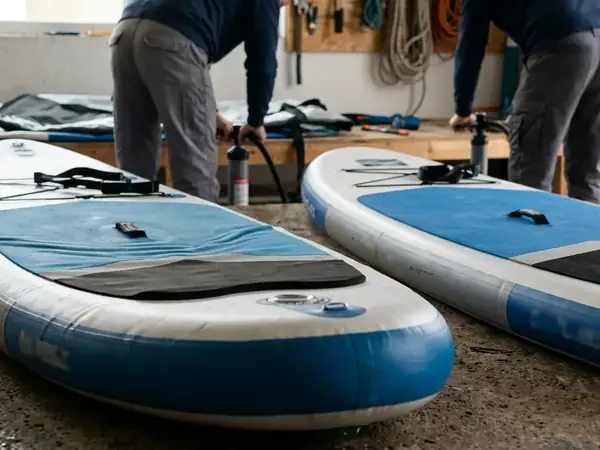
Remove the fin before rolling. Put the fin screw, plate, or clip in a zip pouch instead of leaving it loose in the bag. Open the valve and fully deflate the board. Keep the valve cap attached or packed where it cannot be crushed. Roll in the direction recommended by the board maker. If no guidance is available, roll evenly without forcing the fin-box area into a sharp bend.
Pack the iSUP Bag for Baggage Handling, Not Just Storage
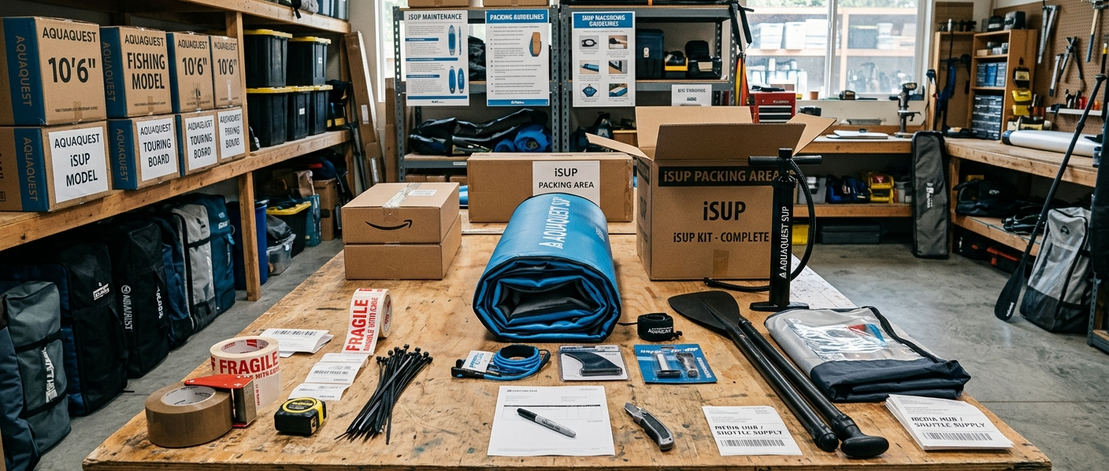
The goal is not a neat closet roll but a bag that can tolerate airport handling. The bag should be organized around pressure points. The rolled board is the soft item being protected, while paddle shafts, pump handles, fins, and tools are the hard hazards.
Place the rolled board so the valve and fin-box area do not sit directly under a pump handle, paddle clamp, fin edge, or repair-tool pouch. Packing a removable fin loose beside the rolled board often results in a hard edge pressing into the board skin during a long baggage transfer. Keep the removable fin in a sleeve, towel wrap, or rigid pouch. Do not let the trailing edge press into PVC fabric during transit.
Packing tip: Use clothing, a towel, a changing robe, a soft PFD, or rash guards as padding around the valve side, fin-box zone, rail seams, and zipper contact points. Avoid loose bulky padding that wastes your weight allowance.
Separate paddle shaft sections with a soft layer so shaft ends and adjustment clamps do not rub the board skin for the entire flight. Pack the pump with the hose disconnected if the hose would kink or push against the board roll.
Handle Pumps, Fins, Batteries, and Safety Gear Separately
A traveler assumes security permission for an electric pump battery means the airline will also accept it without checking battery watt-hour limits. This assumption leads to confiscated gear. Sort accessories by screening and damage risk instead of dumping everything into the board bag.
Manual pumps are usually simplest in checked luggage when the handle, hose, and gauge are protected from bending or direct impact. Electric pumps require a battery decision before packing. Lithium spare batteries are generally handled differently from the pump body and should be checked against current airline and screening rules.
For lithium-ion batteries, the commonly referenced passenger-aircraft thresholds are 100 Wh without special airline approval and up to 160 Wh only with airline approval for limited spare batteries. Verify the current rule before travel. Repair adhesive, solvents, sealants, knives, multitools, fishing pliers, and blades should not be casually placed in carry-on luggage. Check the official TSA What Can I Bring tool for the current screening category of batteries, tools, liquids, adhesives, knives, and pump accessories.
At the Airport: Make the Bag Easy to Accept and Inspect
How do you keep an oversize bag moving smoothly through the terminal? Make the bag boring to accept and easy to inspect. Staff should be able to identify it, tag it, lift it by visible handles, and route it to the correct belt without the bag snagging on machinery.
Arrive 30 to 45 minutes earlier than your normal domestic check-in plan when carrying a large sports bag. Some airports send these bags to a separate counter or oversize belt, which takes extra time. Remove old airline tags and barcode stickers before leaving home so the bag does not carry conflicting routing information. Leave backpack straps, side handles, or grab handles accessible rather than buried under loose cords or rain covers.
Airport Handoff Checklist
Scope and Limitations
- Packed bag weighed after all gear and padding are inside
- Old baggage tags and barcode stickers removed
- External luggage tag attached
- Internal identification card packed inside the bag
- Handles and straps accessible for staff
If asked what is inside, use a specific description: "inflatable paddleboard, deflated, no compressed gas cylinder." Fragile handling requests can communicate care but should not be treated as a promise of separate handling.
After Landing: Inspect Before You Paddle
Do not head straight to the water without checking the board after transit. Transit damage, missing fins, and valve problems are easier to handle at the lodging or rental car than at the launch ramp with no cell service.
Inspect the outside of the travel bag first for torn seams, crushed corners, wet patches, missing zipper pulls, or a detached luggage tag. Unroll the board on a clean surface before adding pressure so grit from the bag does not scrape the deck pad or underside.
Watch for: Inflating a board without checking the valve area, valve cap, fin box, rail seams, D-rings, carry handles, and deck pad edges can turn a minor transit abrasion into a major structural failure under pressure.
Confirm the fin, leash, pump hose, paddle clamps, and repair pouch are present before driving to the launch. Inflate gradually and pause partway through to listen near the valve and seams for obvious air leaks.
Baggage fees, oversize handling, lithium-battery rules, and international screening procedures change by carrier, country, route, fare class, and aircraft size. A strategy that works perfectly for a domestic hop may fail entirely on an international connection.
This guidance is aimed at recreational inflatable SUP travel, not commercial freight, expedition cargo, hard paddleboards, airline employee travel benefits, or shipping boards as cargo. Your final preflight check should include the current airline policy, current screening rules, a home weight check, accessory separation, luggage labeling, and an arrival inspection.
This guide outlines common preparation sequences, but it cannot guarantee airline acceptance, fee waivers, TSA decisions, international screening outcomes, or damage-free baggage handling across all global carriers.