In this Article
- Glove Access Comes Before Extra Rod Capacity
- A Mountain Reservoir Exposed the Limits of a Small Fishing Deck
- Cold-Water Safety Determined What Could Stay on Deck
- Rod Holders Had to Clear the Paddle Stroke and Release Reliably
- The Tackle Crate Needed Restraint Without Blocking Recovery
- Drybag Access Became a Closure-and-Reach Problem
- What Survived Freezing Spray—and What Required a Rebuild
- The Winter Trout Rig Worth Repeating
Glove Access Comes Before Extra Rod Capacity
Glove-operable access deserves priority over extra rod capacity on a winter trout iSUP. Warm-weather SUP fishing setups often prioritize maximum gear carriage, stacking extra tubes and utility tracks around the standing area. Cold-water operations punish that approach. An attachment's actual value on the water depends on the whole operational sequence: reaching the mount, opening the latch or closure with insulated hands, retrieving the equipment, and securing the setup again without losing stability.
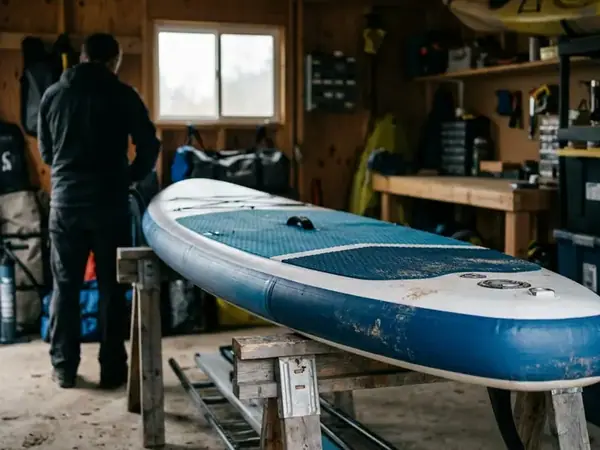
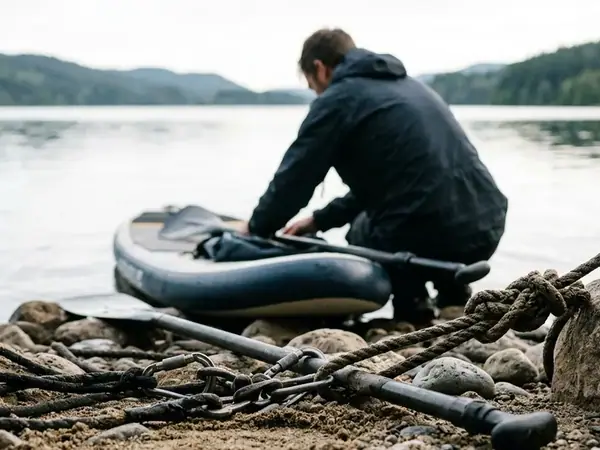
One angler's winter season on a stocked mountain reservoir illustrates how quickly deck layouts face pressure when temperatures drop. Working from a 10-foot-6-inch inflatable paddleboard, the angler navigated freezing spray that coated deck hardware and forced mid-season rigging changes. The starting equipment categories were straightforward: rod holders, a mounted tackle crate, and a drybag. Evaluating how those components interact requires looking past static storage capacity and examining how each piece functions when water freezes on contact.
A Mountain Reservoir Exposed the Limits of a Small Fishing Deck
On a compact 10-foot-6-inch inflatable hull, rod storage, tackle organization, and drybag placement directly compete with the open deck area required for paddling, shifting posture, and climbing back aboard. Every square inch assigned to accessories and rigging shrinks the working footprint. When an angler moves through the standard operational sequence—launch, paddle to a holding line, secure the paddle, handle the rod, retrieve tackle, and stow equipment before returning—crowded hardware turns minor transitions into balance hazards.
Reconstructing the exact starting arrangement requires separating verified baseline facts from unrecorded setup details. While the 10-foot-6-inch board length and the presence of rod holders, a mounted tackle crate, and a drybag are established in the seasonal summary, the initial documentation leaves board width, exact holder count, mounting side, and crate position unrecorded. A complete layout audit requires original full-deck photographs, dated trip notes, and repair logs to distinguish contemporaneous observations from retrospective recollections, as this single-angler seasonal account represents an operational case rather than a controlled comparison across equipment models.
Mapping that working sequence against deck space shows why isolated product close-ups fall short during layout analysis. A mount only succeeds if it clears the paddle shaft during forward strokes and leaves the central deck uncluttered when the angler transitions from standing to kneeling.
Cold-Water Safety Determined What Could Stay on Deck
Does a rock-solid accessory mount justify its footprint if it blocks a cold-water self-rescue? In winter reservoir conditions, safety and board care dictate layout boundaries before fishing convenience enters the conversation. Accessory placement must preserve an unobstructed standing or kneeling zone, a clean paddle path, and a practicable reboarding route over the rail. If a rigid fixture sits where an angler needs to pull their chest onto the deck after an unexpected immersion, that fixture represents a layout failure regardless of how securely it holds a trout rod.
Cold-Deck Clearance Mandate
Inaccessible emergency equipment, compromised attachment security, or surface icing that prevents normal hardware operation is an immediate reason to abandon a launch or return to shore before conditions deteriorate.
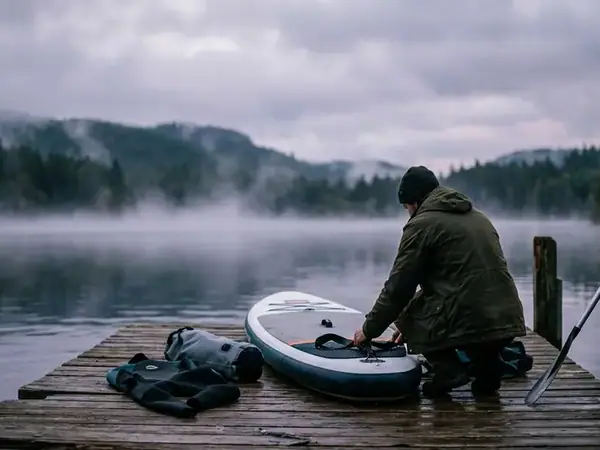
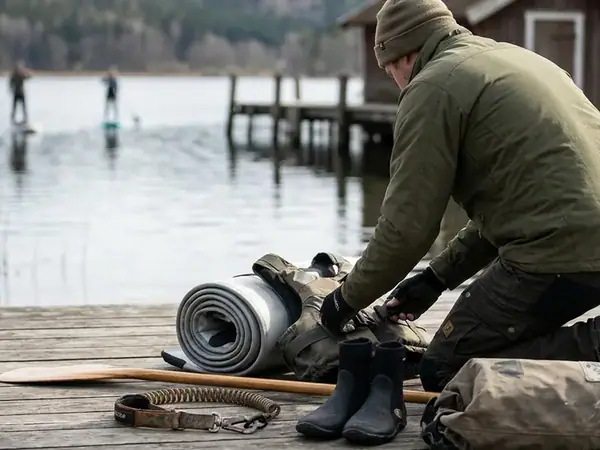
Rigging adjustments never make freezing-water paddling safe on their own. Before launching into winter water, the operational protocol requires an appropriate personal flotation device, immersion-rated clothing, an accessible communication device carried on the body, a designated shore contact, and a conservative return plan. Leash selection also demands environment-specific evaluation. Rather than applying a single leash configuration to every venue, paddlers must weigh reservoir wind exposure against submerged timber, dock pilings, or moving-water entanglement hazards.
All glove-access verification belongs on dry land. Testing emergency-equipment reach and hardware releases on shore with winter gloves prevents discovering a jammed mechanism offshore, avoiding any reliance on deliberate immersion or on-water equipment failure as a test method.
Rod Holders Had to Clear the Paddle Stroke and Release Reliably
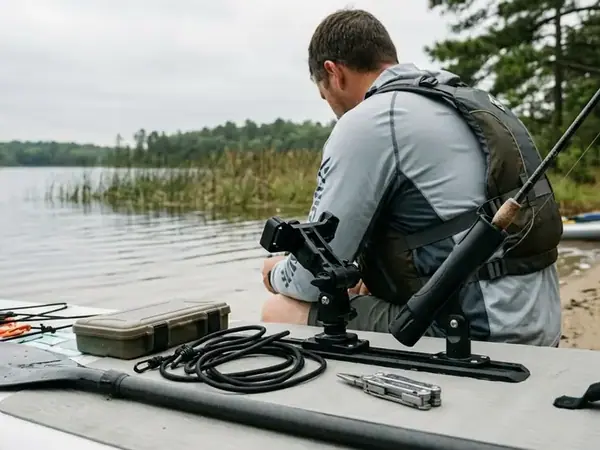
Evaluating a winter rod holder requires splitting its performance into three separate mechanical questions. First, did the base remain firmly attached to the board? Second, did the angle or rotational adjustment mechanism remain operable under spray? Third, could the angler draw the rod out promptly while wearing thick winter gloves? A mount that stays glued to the PVC skin can still fail the mission if ice locks its release collar or if its profile fouls the paddle blade.

Reconstructing the original holder location from seasonal notes and full-deck photographs centers on three geometry variables: reach from a seated or kneeling posture, rod-tip clearance during casts, and complete separation from the vertical paddle stroke. When evaluating any report of paddle contact, rigging analysts record the exact holder coordinates and the specific stroke phase involved rather than writing the issue off as generic awkwardness. Similarly, rod removal efficiency should only be stated as a time metric when backed by an actual timed task record; otherwise, the assessment relies on qualitative observation without estimating seconds.
Freezing spray introduces specific mechanical inspection points across any holder assembly:
- Adjustment knuckles and toothed gears: Exposed teeth and tension knobs collect water droplets that freeze into solid collars, preventing angle changes once on the water.
- Locking rings and retention straps: Sliding collars or elastic loops require fine finger dexterity that insulated gloves obscure.
- Base track channels: Recessed slots can trap slush around mounting bolts, turning tool-free adjustments into fixed positions until thawed.
These junctions serve as critical pre-launch inspection points unless specific trip logs verify them as actual seasonal failure locations.
The Tackle Crate Needed Restraint Without Blocking Recovery
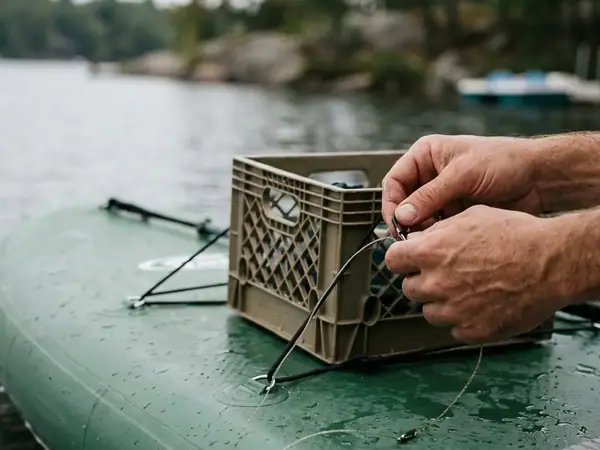
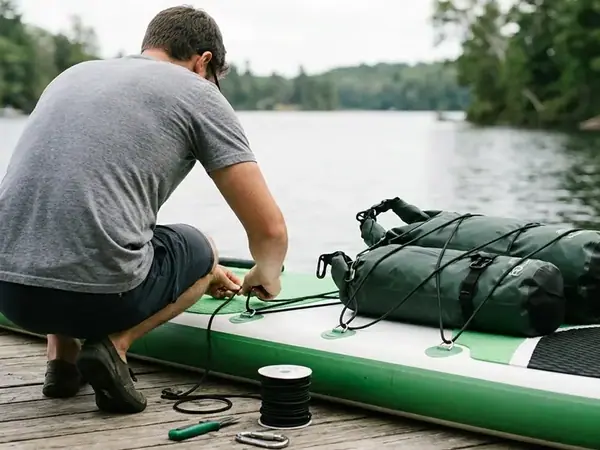
A mounted tackle crate serves competing functions on a narrow inflatable deck: it consolidates loose boxes, frequently supports secondary rod tubes, and keeps terminal tackle within arm's reach while attempting to leave the primary standing zone intact. Achieving that balance depends on how the crate connects to the hull. Rigging analysis distinguishes between flexible retention—such as light bungee cordage that stretches under load—and positive restraint designed to prevent shifting, while also checking whether the board's existing D-rings or glue pads are actually intended by the manufacturer to handle concentrated lateral loads.
Because the initial seasonal summary confirms a mounted crate without naming its exact fasteners or tie-down points, documenting the hardware requires tracing the full strap routing before critiquing the mount. A thorough rigging inspection checks four physical details:
- Strap geometry and tension retention: Whether webbing runs straight to anchor points without slackening when wet or iced.
- Buckle positioning: Whether release hardware sits upright and clear of the crate overhang so gloved fingers can pinch or pry it open.
- Loose strap tails: Whether excess webbing is secured so it cannot loop around boots or paddle shafts.
- Recovery zone clearance: Whether the crate footprint or its tie-downs intrude into the rear or side reboarding path.
Rigorous deck audits avoid translating casual remarks that a crate barely moved into invented millimeter measurements, and they never infer capsize-retention capability from ordinary flatwater paddling observations. When measuring crate displacement on future outings, the protocol requires marking a fixed deck reference point and measuring to the same crate corner before and after normal use, recording the exact measurement method alongside the result.
Drybag Access Became a Closure-and-Reach Problem
A drybag that keeps spare layers bone-dry still fails as deck cargo if opening it forces the angler to unclip the tackle crate or drop the paddle into the bilge water. Evaluating drybag utility on a winter iSUP means tracking one uninterrupted task chain: secure the paddle, reach the bag from a stable posture, release any deck tie-down, operate the bag closure while wearing paddling gloves, retrieve the needed item, reseal the closure properly, and restore the deck restraint.
Gloved Closure Verification
Waterproof integrity and operational access are separate metrics: a closure that opens easily does not prove water protection, and a dry interior at the ramp does not prove quick on-water access.
In the supplied reservoir case, the exact drybag closure style, orientation, deck placement, and any specific component failure remain unverified in the baseline summary. Analysis of the setup focuses on workflow bottlenecks rather than blaming a hypothetical roll-top buckle or waterproof zipper. If reaching the bag requires moving a stowed rod, undoing a shared crate strap, or dragging the bag across an iced deck into the kneeling zone, each extra motion increases exposure time in cold wind.
Rehearsing the full retrieval and resealing cycle on shore—wearing the exact gloves and managing the secured load planned for the session—exposes reach limits immediately. Essential safety communication gear must stay clipped to the paddler's PFD, completely independent of this deck-access routine.
What Survived Freezing Spray—and What Required a Rebuild
Establishing what worked and what froze solid requires separating general seasonal summaries from component-level proof. The baseline account confirms that winter spray coated the rig and forced mid-season rebuilding on the 10-foot-6-inch board, yet that high-level summary does not assign specific survival or failure outcomes to the rod holders, the tackle crate, or the drybag. Attributing a frozen latch to the rod holder or a snapped buckle to the crate without direct trip logs would invent hardware failures that the summary leaves open.
To keep the case study grounded in verifiable evidence, the table below structures the required audit across each rigging category. Entries distinguish between contemporaneous records (dated trip notes, repair receipts, and full-deck photos) and retrospective angler recollections, while noting that missing source documentation does not automatically establish whether a task went untimed or unmeasured.
| Component | Original Arrangement | Observed Problem or Retained Function | Mid-Season Change | Outcome After Change |
|---|---|---|---|---|
| Rod Holders | Mounted on 10'6" iSUP deck; exact count, side, and track/pad interface awaiting photo verification. | Evaluated across three distinct points: base security, adjustment mobility under freezing spray, and gloved rod release. | Pending component-level log confirming whether holders were relocated, replaced, or retained unchanged. | Requires separation of immediate post-adjustment shore checks from multi-outing spray performance; rod release timing recorded only if a timed start-to-finish log exists. |
| Tackle Crate | Deck-mounted storage crate; specific fastener hardware, D-ring routing, and fore/aft position awaiting record confirmation. | Assessed for flexible retention vs. positive restraint, buckle reach with winter gloves, and clearance along the reboarding route. | Pending verification of whether mid-season rebuild altered tie-down routing, hardware type, or crate footprint. | Displacement evaluated via fixed deck reference point to crate corner before and after use; qualitative observations retained where distance was not measured. |
| Drybag | Secured on deck; exact closure mechanism, orientation, and tie-down sharing awaiting trip-note verification. | Audited across the full gloved cycle: paddle stowage, bag reach, restraint release, closure operation, item retrieval, reseal, and re-restraint. | Pending confirmation of whether bag position or restraint clip was modified to eliminate interference with rods or crate. | Water protection assessed separately from gloved cycle speed; access timing reported only if supported by a timed task record. |
Notice the strict separation between visible surface ice and actual mechanical seizure. A mount coated in white rime has not failed if the rod still slides free and the base resists torque. When documenting before-and-after performance across mid-season modifications, rigging logs must record ambient weather, spray exposure, glove thickness, and total deck load alongside hardware swaps so the analysis does not credit a new fastener for an easier trip conducted on a calmer, warmer afternoon.
The Winter Trout Rig Worth Repeating
Building a reliable cold-water fishing platform starts with task dependency rather than accessory count. Every piece of gear bolted or strapped to the PVC skin must justify its footprint through accessible, gloved function. When configuring a winter deck, prioritize layout decisions in this strict order:
- Preserve the recovery and working deck: Keep the central standing/kneeling zone and the side reboarding route completely free of rigid mounts and high-tension straps.
- Position rod holders for stroke clearance and gloved draw: Place holders within natural seated or kneeling reach where neither the base nor the rod butt intersects the paddle path.
- Restrain the tackle crate with accessible hardware: Route tie-downs to prevent lateral shifting while keeping buckles exposed and clear of the recovery zone.
- Orient the drybag for an independent access cycle: Secure the bag so gloved hands can unclip, open, retrieve, reseal, and re-secure it without disturbing rods or crate straps.
Pre-Launch Shore Rehearsal
Before stepping onto the water in winter conditions, put on your paddling PFD and winter gloves on shore to physically run through five checks: swing the paddle through a full stroke to verify clearance, trigger every rod and tether release, open and reseal the drybag, inspect crate restraint tension, and confirm one-handed access to body-worn emergency communication gear.
The rod holders, tackle crate, and drybag occupy the same 10-foot-6-inch inflatable deck used for standing, kneeling, and reboarding.