In this Article
- The Core Test: Can the Board Let You Fish, Not Manage Gear?
- Stability Starts With Width, Shape, and Deck Stiffness
- A Clean Deck Is More Valuable Than a Crowded Deck
- Rigging Points Should Support the Way You Actually Fish
- Storage Capacity Only Helps If the Load Stays Balanced
- The Best Fishing SUP Still Has to Paddle and Hold Position
- Comfort Features Matter Most After the First Hour
- Safety and Required Gear
- Scope and Limitations
- Pre-Trip Fishing SUP Checklist
The Core Test: Can the Board Let You Fish, Not Manage Gear?
What actually defines a fishing-friendly paddleboard? Many buyers look at the number of accessory mounts or the sheer volume of cargo space. In practice, a board earns the fishing label only if it helps the angler execute the entire sequence: launch, paddle, position, cast, fight a fish, land it, stow gear, and return.
The minimum functional test is straightforward. You must be able to stand securely, make a normal cast, reach your primary tackle box, control the paddle, and land a fish without stepping over loose gear. A fishing setup should be judged after rods, tackle, water, safety gear, and any cooler or crate are loaded, not while the board is empty.
Critical Insight: Fishing-friendly does not always mean maximum size. It means a balanced design optimized for the intended water and the specific angler.
Stability Starts With Width, Shape, and Deck Stiffness
Stability dictates every movement on the water. We evaluate this through primary stability for standing still and secondary stability for edging, shifting weight, or fighting a fish. For many recreational SUP fishing setups, boards in the mid-30-inch width range are common because they offer more standing confidence than narrower touring-style boards without becoming barge-like for short paddles.
Shape plays an equally vital role. A fuller tail helps when you step back to land a fish or reach aft storage. Conversely, a narrow tail can feel twitchy under a loaded crate or cooler.
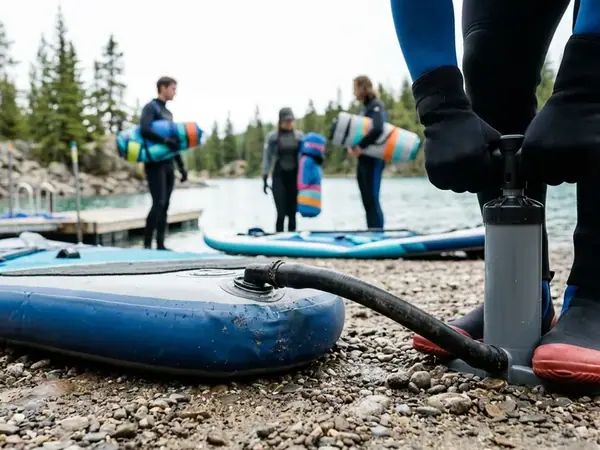
Inflatable boards must be inflated to the pressure range printed by the manufacturer before judging stiffness. Many current iSUPs list maximum pressures in the 12 to 20 psi range. Deck flex becomes highly noticeable when a heavy tackle box, cooler, or anchor kit is placed near the standing zone instead of being secured low and centered. A wide inflatable board can still feel unstable if a heavy cooler is strapped high behind the angler and the center deck flexes under load.
A Clean Deck Is More Valuable Than a Crowded Deck
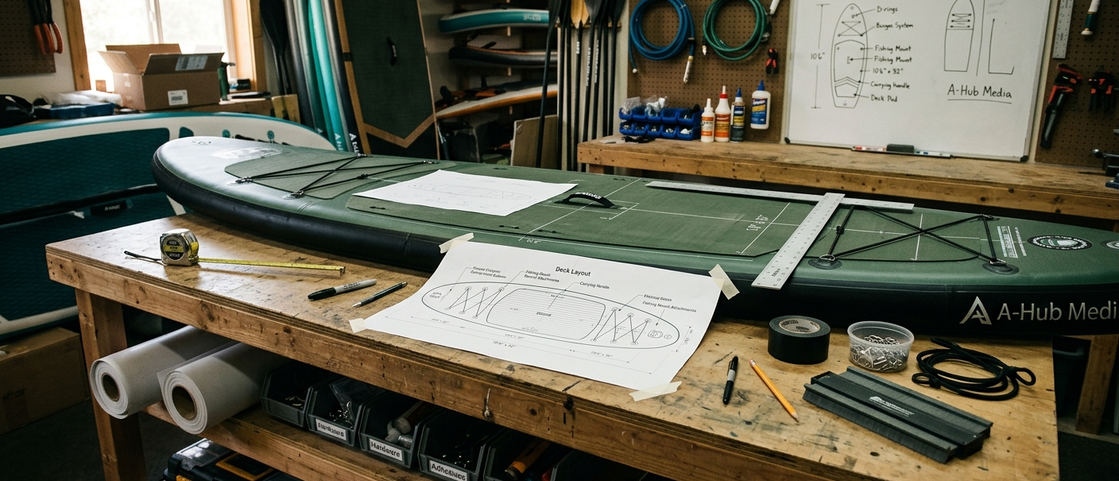
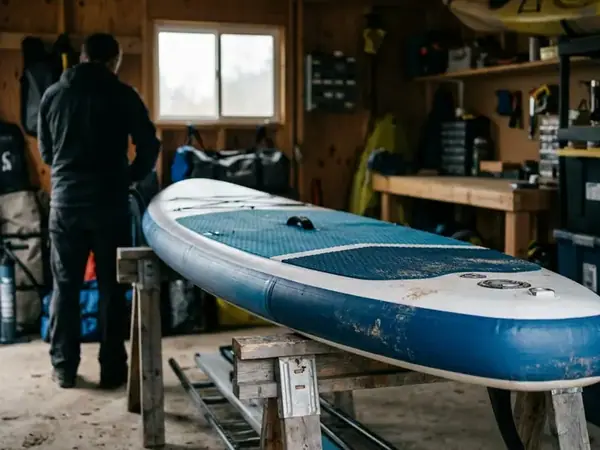
Start your deck assessment from the stance area and work outward. A practical dry-land deck test takes 3 to 5 minutes. Step forward, step back, kneel, rotate as if casting, reach for pliers, and simulate landing a fish beside the rail. If the central pad is not clear enough for foot movement, the board may look fishing-ready but will behave poorly once you start casting.
The central standing area should allow a shoulder-width stance, a half-step back, a kneel-down motion, and a torso rotation without contacting rods, tackle bags, raised bungees, or anchor lines. EVA deck pad coverage and traction texture directly affect your casting balance.
Risk Factor: Raised bungee cords crossing through the middle of the deck create a predictable trip point. Keep them forward or aft of the main stance zone.
Loose rod handles should be clipped, laid flat, or placed in holders so they do not roll underfoot when the board rocks. Keep the central stance area entirely clear while placing storage forward, aft, or along the rails.
Rigging Points Should Support the Way You Actually Fish
How should you evaluate attachment points? Judge them by reach and purpose, not by quantity. A mount that cannot be reached while seated, kneeling, or standing is less useful than a plain D-ring placed exactly where it secures a needed dry bag.
Useful hardware includes D-rings for tie-downs, threaded mounts for rod holders or camera arms, accessory tracks for adjustable placement, bungee zones for soft storage, paddle holders, and cooler tie-down locations. A board with ten mounts may fish worse than a board with four well-placed D-rings if the rod holders, paddle clip, and tackle bag force the angler to step over gear.
Different environments demand different layouts. For freshwater bass fishing, the primary rod holder and tackle box usually need to be reachable without turning fully around. Inshore sight casting requires open deck space and a low-profile rod layout. Casual bait fishing may need a small cooler, bait container, pliers, and one or two rod holders. Lure fishing often favors quick access to a compact tackle tray and a net. A modular setup should be removable in one packing session so the same board can serve for travel paddling or non-fishing family use.
Storage Capacity Only Helps If the Load Stays Balanced
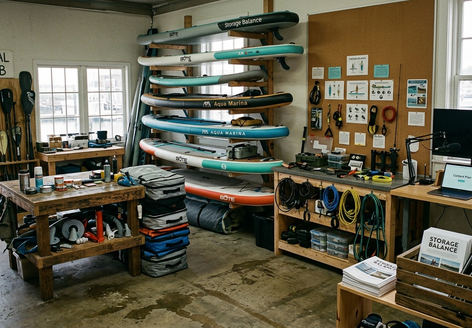
Plan your storage from the board's trim line rather than from the amount of empty deck space. Tackle boxes, soft coolers, dry bags, anchor kits, and fish bags fundamentally change board trim.
Dense items such as tackle boxes, small anchors, water bottles, and tool rolls should be secured low and near the middle first. Lighter rods, soft dry bags, or fish bags are added only after the core weight is balanced. In practice, a bow-loaded board can slap and push water when paddling into chop, while an aft-loaded board can squat and lose clean tracking.
A front bungee that is convenient on calm ponds can make the bow heavy and noisy when paddling into reservoir chop with a loaded tackle bag.
Recommendation: Rig the board at home once with the actual paddle, PFD, rods, tackle, water, anchor kit, and cooler. Remove any item that does not have a defined job for that trip. Dry-land packing should include lifting or carrying the loaded board a short distance. A setup that cannot be moved safely on shore is usually too cluttered for launch.
The Best Fishing SUP Still Has to Paddle and Hold Position
Assess the board after loading because glide, tracking, and wind handling change once crates, rods, and coolers are onboard. A longer center fin can improve straight-line tracking on open water. A shorter fin is less likely to strike bottom in shallow flats, creeks, or weedy ponds.
Positioning tools require careful selection. Stake-out poles are most useful in shallow, soft-bottom areas where the pole can be planted securely. Small anchors require a clean line path and a release plan. A drift sock can slow the board in wind or current, but it adds another line that must be kept away from hooks, fins, feet, and leash hardware.
High coolers, vertical rods, and tall crates increase windage. This becomes highly apparent during crosswind paddling or when trying to hold position near structure. A fishing SUP still has to return home when wind or current changes.
Comfort Features Matter Most After the First Hour
Evaluate comfort after the first hour rather than during the first few minutes. Standing feels efficient for casting, but kneeling, sitting, and changing posture often determine whether the setup remains viable for a full day.
A full-length or extended deck pad helps anglers switch between standing, kneeling, and seated positions without placing knees on bare PVC or hard rail material. A low seat improves rest and back support but can make transitions to standing slower, especially when a tackle box or paddle lies across the movement path.
Using a cooler as a seat raises the center of gravity more than a low fabric seat and can make the board feel less settled when boat wakes pass. The paddle, net, pliers, and primary tackle box should be reachable from the main fishing posture without leaning past the rail. Seat attachment points should never interfere with your paddling stroke or deck movement.
Safety and Required Gear
What safety equipment is mandatory for a fishing paddleboard? SUP fishing adds hooks, lines, blades, cargo, and distraction to normal paddling risk. Paddlecraft safety guidance emphasizes that preparation prevents minor gear failures from becoming emergencies.
The U.S. Coast Guard paddlecraft safety guidance treats paddleboards used outside swimming, surfing, or bathing areas as vessels for federal equipment purposes. This includes carriage of an appropriate life jacket and a sound-producing device.
Carry a properly fitted PFD, whistle or other sound signal, sun protection, drinking water, and a knife or line cutter where entanglement from fishing line, anchor line, or leash hardware is possible. Leash choice should match the water. Coiled leashes are common on flatwater, while moving water can require quick-release systems and specific training. Anchors, drift lines, and heavy gear should attach to the board or a releasable rigging point, not directly to the angler's body.
Scope and Limitations
Treat this framework as a feature-selection guide, not a definitive model ranking. The exact same board feature can be an advantage or a nuisance depending on water type, angler size, skill, wind exposure, and how far the launch is from the fishing spot.
Protected ponds reward quiet deck layouts, short paddling efficiency, and simple anchoring. Tidal flats favor shallow fin choices, low wind profile, and clean casting space. Slow rivers add current management and line-control concerns. Windy reservoirs place more value on tracking, lower cargo height, and the ability to paddle back efficiently. Cold water, remote shorelines, and offshore wind increase the importance of rescue planning, communication, clothing, and conservative load choices.
This framework assumes recreational SUP fishing in conditions where the paddler has the skill, clothing, and rescue margin to return without outside assistance.
Pre-Trip Fishing SUP Checklist
Use a pre-launch routine that tests the board as a complete system. Plan a 10 to 15 minute setup check before launch when fishing gear is involved. Take longer if the board is newly rigged or the anchor system has changed.
Changing one rigging item between trips helps the angler tell whether a new mount, crate position, anchor setup, or storage bag actually improves efficiency. Before entering the water, perform a deck-walk test. Step, kneel, rotate, reach for the net, reach for pliers, and simulate bringing a fish alongside the rail.
Pre-Launch Fishing SUP Setup Check
- Board inflated to the manufacturer's printed pressure range
- Fin installed and locked
- PFD fitted and accessible before launch
- Leash selected for the water environment
- Paddle reachable from standing, kneeling, and seated positions
- Sharp tools sheathed or clipped securely
The final setup should remain stable, uncluttered, controllable, and safe after the actual fishing load is onboard.