In this Article
- Opening Position: Not Every Angler Needs a Hull
- The Real Advantage: Access Beats Horsepower
- Where a Fishing SUP Actually Outperforms a Small Boat
- Where the Boat Still Wins—and It Is Not Close
- Rigging Turns a Board Into a Fishing Platform
- Safety Is the Platform Decision, Not an Afterthought
- My Decision Rule: Match the Craft to the Fishing Day
Opening Position: Not Every Angler Needs a Hull
A paddleboard is not a universal fishing boat replacement. It is the better tool when access, quiet movement, simplicity, and shallow-water reach matter more than capacity or horsepower. A solo angler carrying one rod, a small tackle box, pliers, drinking water, and a compact cooler rarely needs a fiberglass hull. The decision comes down to the water type, the weather, the distance from shore, and the target presentation.
Critical Insight: Choose the platform around the water, the weather, the distance, and the fish—not around tradition.
Many anglers default to a boat because it feels like the standard requirement for getting off the bank. This mindset ignores the logistical drag of trailers, ramps, and maintenance. When you strip away the desire to run fast across open water, the actual requirements for catching fish in protected areas are remarkably minimal.
The Real Advantage: Access Beats Horsepower
In practice, a realistic before-work fishing window is 60 to 90 minutes from parking to leaving. Launch friction matters more than top speed here. An inflatable fishing SUP can usually be moved from a vehicle to the shoreline in one walking trip. The angler keeps the load to a board bag, paddle, pump, PFD, rod, and one small gear container.
Farm ponds, small lakes without developed ramps, marsh edges, creek mouths, protected coves, and backwaters turn a trailer into a burden. The setup sequence is short. Pump the board, install the fin, clip on safety gear, secure the crate or soft cooler, and launch.
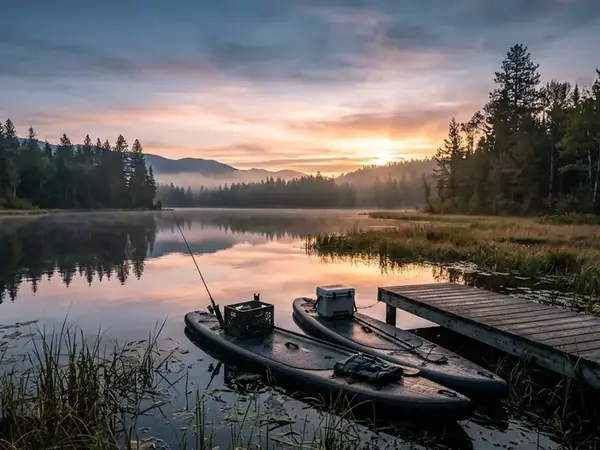
A paddleboard can beat a small boat for a dawn session not far from 75 minutes in a shallow cove because the launch is simple and the target water is close. You spend your time casting rather than backing down a concrete ramp or waiting in line at a marina.
Where a Fishing SUP Actually Outperforms a Small Boat
When does a piece of drop-stitch PVC outfish an aluminum hull? Sight-fishing shallow flats is a strong case when the water is calm enough for standing. The angler moves by short paddle strokes instead of constant repositioning with a motor. Reed lines and marsh edges favor a board when sliding along vegetation, stopping quickly, and making short casts into pockets without hull slap.
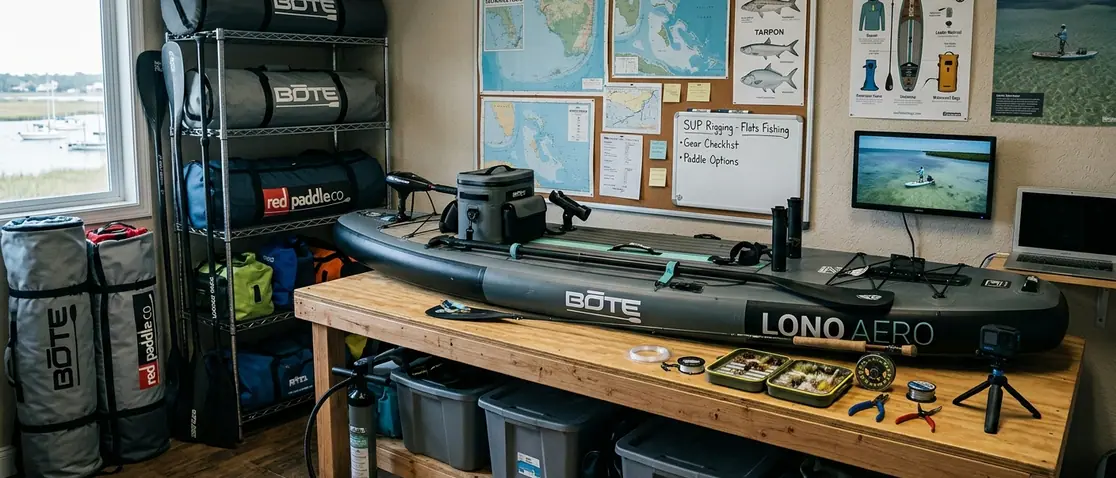
Dock-line fishing favors a SUP when working 20 to 40 yards of structure at a time rather than running long distances between spots. No-ramp water is a core advantage. The board launches from grass, sand, gravel, or a low bank where a trailer cannot be backed safely.
Recommendation: If the plan fits one rod, a small tackle box, pliers, water, sun protection, and a compact cooler, the SUP is probably operating in its best range.
Where the Boat Still Wins—and It Is Not Close
A boat holds the clear advantage when the day requires multiple anglers, several rods per person, large tackle trays, batteries, electronics, a live well, a large cooler, or long runs between fishing areas. SUP recommendations become poor judgment in strong wind, noticeable current, cold exposed water, offshore routes, large wakes, night fishing, or any plan that puts the angler far from an easy landing.
Risk Factor: For many recreational paddlers, sustained wind in the 12 to 15 knot range is enough to turn a casual fishing paddle into a control problem, especially with a rod, crate, and raised body position.
The same paddleboard becomes the wrong tool when a breeze builds across open water and the return route is into the wind with a crate, rod, and anchor aboard. Cold-water margin changes the platform decision. Falling in while managing hooks, line, anchor rope, and loose gear is not the same as stepping off a board on a warm pond.
Rigging Turns a Board Into a Fishing Platform
The difference between a useful fishing SUP and a frustrating one is rigging restraint. In practical scenarios, a useful inflatable fishing SUP range is roughly 10 feet 6 inches to 12 feet 6 inches long and 32 to 36 inches wide. The final choice depends on rider size, water texture, and gear load.
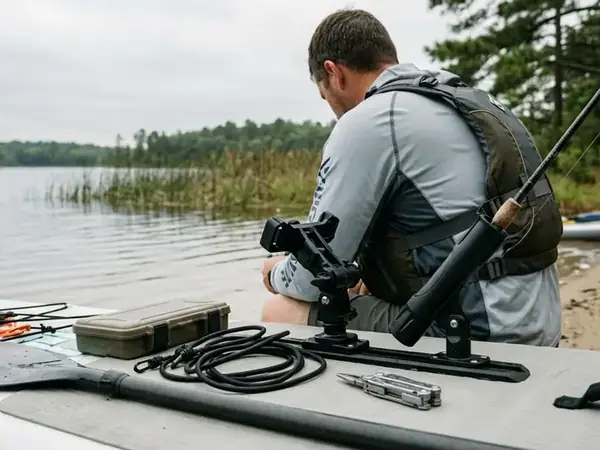
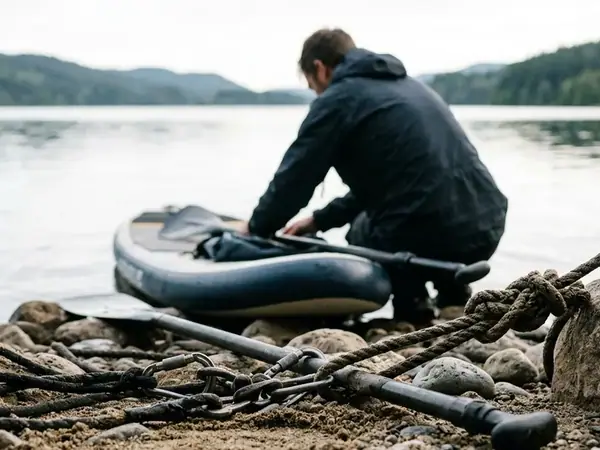
Keep hard items centered and low. Place the crate or soft cooler behind the standing area. Keep tackle inside a closed box or bag. Clip or tether tools where they will not roll underfoot. A calm-water anchor for SUP fishing is usually a small folding or mushroom-style anchor in the 2 to 3 lb range. It should be easy to release and should not be used where current can pin the board.
Essential setup elements are a stable inflatable SUP, paddle, properly fitted PFD, leash where appropriate, one rod holder, crate or soft cooler, dry bag, pliers, compact tackle, drinking water, and a simple anchor system suited to calm water. Testing order matters. Paddle unloaded for 15 to 20 minutes. Add the crate. Practice casting from both sides. Rehearse kneeling and standing transitions. Add accessories one at a time. A wide fishing SUP is not automatically stable; load placement, rider balance, fin depth, water texture, and casting motion all change the result.
Safety Is the Platform Decision, Not an Afterthought
How do you ensure a simple fishing trip stays simple? Check the weather before leaving home and again at the launch. A small wind shift can matter more to a paddleboard than to a powered boat. Carry a communication device in a dry case attached to the paddler or PFD, not loose in a crate that can separate from the board.
Practice deep-water re-entry before fishing with rods, hooks, and anchor line aboard. The first attempt should not happen after an accidental fall. Use a properly fitted life jacket consistent with U.S. Coast Guard life jacket guidance, and treat it as worn safety gear rather than cargo.
Set a conservative turnaround point before launching. Turn back while the return paddle still looks routine rather than waiting until wind, fatigue, or current makes the decision.
My Decision Rule: Match the Craft to the Fishing Day
Choose the paddleboard for protected water, short range, easy landing options, one-person simplicity, and a disciplined kit built around one rod or a minimal rod setup. Choose the boat for long runs, multiple anglers, heavy tackle, larger coolers, electronics, changing weather, current, cold water, or any plan where a fall would create a serious recovery problem.
This framework applies strictly to recreational SUP fishing in manageable protected conditions, not offshore angling, tournament boat fishing, commercial guiding, or big-water days where rescue distance and exposure dominate the decision.
Paddleboards are not budget boats. They are specialized tools for quiet, shallow, low-friction fishing days.