In this Article
- A Sheltered Launch, Then a Board Moving Away From Shore
- Why Calm Water at the Launch Can Hide Offshore Wind
- The Decisions That Let Offshore Drift Become a Rescue
- Which SUP Accessories Help When the Return Paddle Fails
- What to Do When You Cannot Make Progress Toward Shore
- A Launch Check Built Around the Return Journey
- Choose a Launch That Keeps the Wind on Your Side
A Sheltered Launch, Then a Board Moving Away From Shore
A paddler steps onto one of the wider, thicker inflatable paddleboards at a calm, tree-lined launch. The water beside the bank is glassy. The first few strokes away from the shoreline feel effortless, gliding past overhanging branches and out toward open water.
Then the board crosses an invisible line beyond the tree canopy. Looking back to check the departure point, the paddler notices the landing shrinking behind the tail of the board even between strokes. Turning the bow back toward the shore reveals the actual problem: the wind that was unnoticeable at the water's edge is pushing straight off the land, and normal paddling effort barely holds the hull in place.
That spatial transition from tree shelter to open exposure frames the core challenge of managing wind on a stand up paddleboard. When assessing paddling skills, board fit, accessories, and rigging, the critical safety margin is defined at that boundary where the departure landmark begins to recede.
Why Calm Water at the Launch Can Hide Offshore Wind
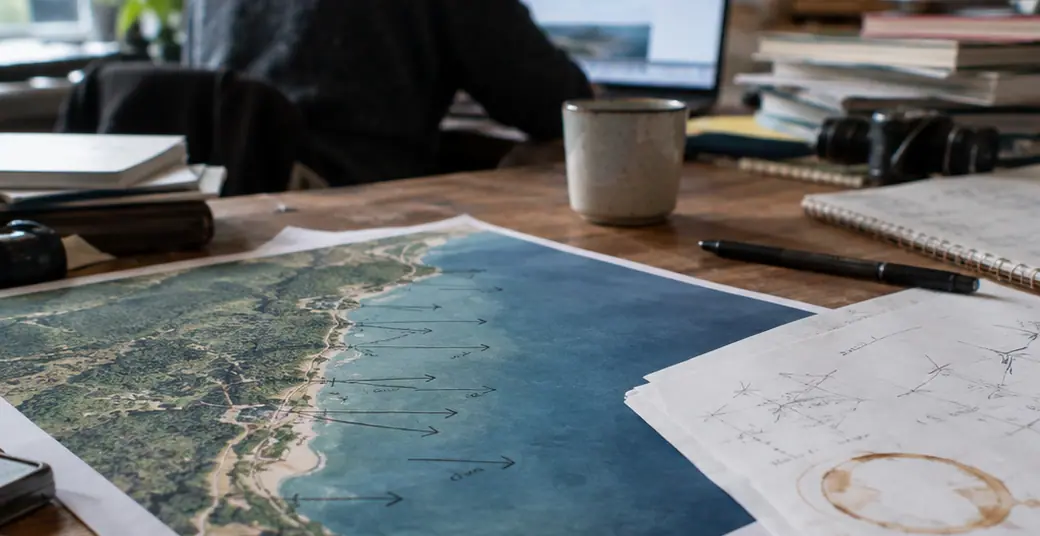
Offshore wind blows from the departure shoreline toward open water, carrying a floating hull away from the land. Because the air moves over terrain before hitting the water, trees, coastal bluffs, waterfront buildings, and headlands block the flow near the bank. Smooth water beside the tree-lined launch is evidence about that sheltered patch, leaving the actual resistance of the exposed return route untested.
Separating a sudden meteorological shift from a simple change in geographic exposure requires reading the environment before leaving the bank. Sometimes a front arrives midday; other times, the wind was blowing across the open water the entire time, masked near the beach by a wind shadow. Assessing wind direction against the intended departure and return shoreline matters far more than a general impression of pleasant weather at the parking lot.
Observable warning signs appear before the board ever leaves the lee of the shore:
- Upper canopy movement: Treetops or exposed ridge vegetation bending or rustling while the air at water level feels still.
- Surface texture boundaries: A distinct line further out where glassy nearshore water transitions into dark ripples, cat's paws, or whitecaps.
- Tactile wind pressure: Air pushing steadily against the paddler's back during the initial strokes away from the beach.
- Shoreward ground-speed loss: Turning the board toward a fixed landmark on the bank and finding that forward strokes produce little closure against that reference point.
Pre-trip planning requires reading the location-specific wind direction, sustained wind, gust forecast, and expected directional shifts through the entire planned return window. Even so, forecasts and shoreline observations at a sheltered launch cannot establish exact conditions across an entire route, and no single wind-speed cutoff accounts for the combined variables of board volume, cargo loading, paddler ability, and local gust funneling.
The Decisions That Let Offshore Drift Become a Rescue
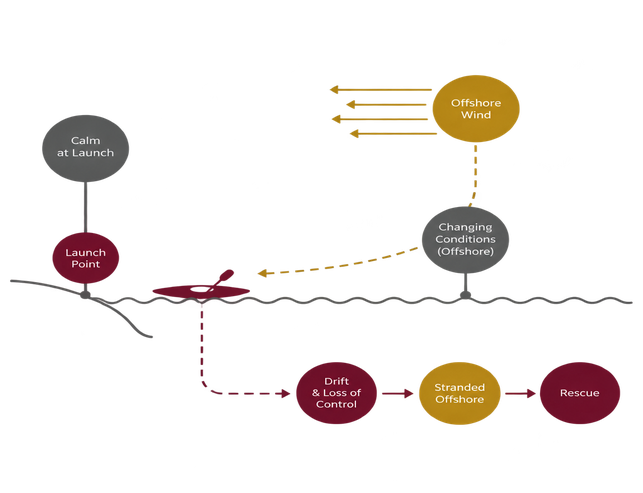
How does a routine afternoon session escalate into an emergency dispatch? The sequence rarely depends on a sudden hardware failure; instead, it follows a chain of delayed decisions.
First, the board exits the wind shadow into exposed water. Next, the paddler attempts to turn back or hold position and notices poor return progress. Rather than treating that stall as an immediate decision point, the paddler continues pulling hard against the wind without reassessing the route. Prolonged high-cadence paddling against a headwind rapidly depletes glycogen and grip strength. Exhaustion sets in while the board continues to lose ground, and the eventual request for outside assistance happens much further offshore than where the struggle began.
Shoreward Progress Rule: After an inflatable SUP leaves tree shelter, loss of progress toward the departure landmark—rather than an eventual capsize—is the decision point that must interrupt the drift sequence.
Evaluating progress requires looking at a fixed landing, a prominent building, or a distinct shoreline feature. Water moving past the rails or physical exertion in the shoulders can create a false sense of headway when the hull is actually stationary relative to the bottom.
Aerodynamic profile plays a heavy role here. High-volume inflatable paddleboards sit on top of the water with high freeboard, and a standing paddler acts as a vertical sail. Lowering the center of gravity to a stable kneeling position reduces the surface area exposed to the wind and allows cleaner blade entry. However, dropping to the knees only trims windage; it does not guarantee that a return against strengthening offshore gusts is achievable. A route that depends on overpowering rising wind has a deteriorating return margin even while the paddler remains upright on the deck.
Which SUP Accessories Help When the Return Paddle Fails
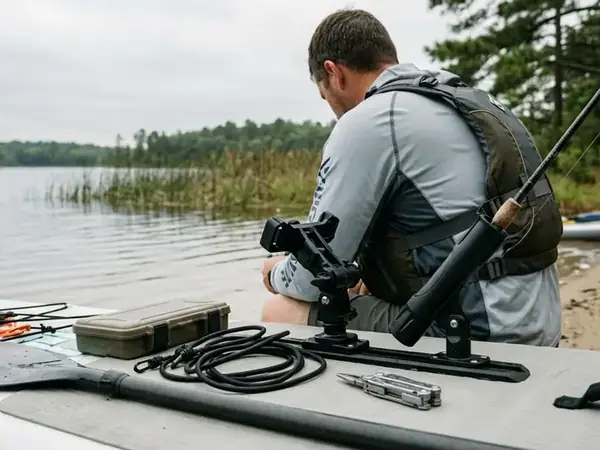
When a return paddle stalls in offshore wind, accessories and rigging shift from convenience items to survival systems. Before loading rods for SUP fishing or strapping down dry bags for a touring trip, rigging must prioritize five distinct emergency functions: wearable flotation, board connection, communication, signaling, and thermal protection.
Flotation and Board Connection
A properly fitted personal flotation device (PFD) worn from the moment of launch is the foundational layer of paddling safety. In an offshore drift scenario, a worn PFD supports survival in the water and reduces the energy required to stay afloat after a fall, though it neither stops wind-driven drift nor eliminates cold-water exposure.
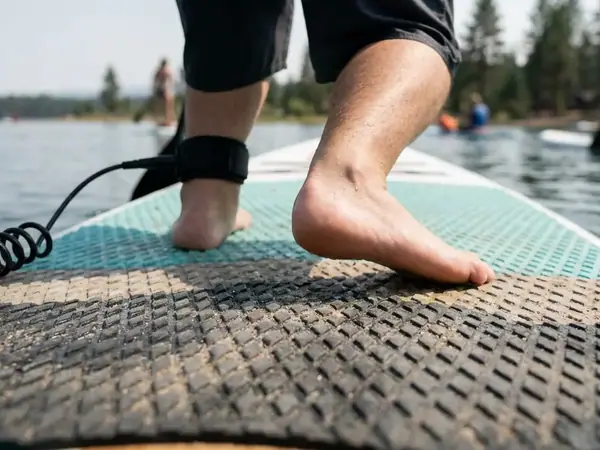
The leash serves as the mechanical link keeping the paddler attached to the largest flotation aid available: the board itself. However, an ankle leash is not a universal prescription for every waterway. Moving water, tidal currents, bridge pilings, and submerged timber introduce severe entanglement hazards where a fixed tether can trap a paddler underwater. Leash selection, attachment point, and quick-release rigging must match the specific environment, and paddlers need hands-on practice pulling that release without looking.
Communication, Signaling, and Thermal Protection
A waterproof communication device—such as a VHF marine radio or a phone sealed in a certified waterproof pouch—must be tethered directly to the paddler's PFD, reachable while floating in the water. Stowing a phone inside a deck-rigged dry bag leaves the paddler without a way to call for help if separated from the hull during a gust. A dry bag protects spare clothes from spray; it offers zero wearable flotation.
Similarly, a pealess whistle belongs clipped directly to the shoulder strap of the worn PFD rather than buried inside a gear hatch. For thermal protection, dress for the water temperature and the likelihood of prolonged wind chill or immersion, ignoring deceptive warm air temperatures at a sheltered parking lot. Hand pumps, patch kits, and spare fins solve mechanical problems at the beach, but they have no bearing on wind-driven separation from shore.
What to Do When You Cannot Make Progress Toward Shore
When forward strokes no longer close the distance to the departure landmark, immediate tactical changes preserve energy and widen the margin for recovery.
- Recognize the stalled return early: Stop burning maximum physical effort against an unyielding headwind.
- Stabilize the hull and lower your profile: Drop from standing to a stable kneeling position—or lie prone if necessary—when safe to do so, cutting wind resistance immediately.
- Reassess reachable landings: Scan the shoreline for closer downwind or angled exits, such as a sheltered cove or adjacent beach, without committing to a longer, more exposed open-water crossing.
- Call for assistance before exhaustion: If no safe landing is reachable, contact emergency responders while you still have the dexterity, core warmth, and breath control to communicate clearly. Waiting for darkness, hypothermia, or repeated capsizes turns a manageable pick-up into a critical search.
When connecting with local emergency services or marine rescue, deliver concise, prioritized data: your current location or GPS coordinates, recognizable shore landmarks, the number of people in your party, a clear description of the board and deck color, your estimated direction of drift, and any immediate medical or exposure concerns. Keep the communication device accessible after the initial call and follow the dispatcher's instructions.
In most open-water drift situations, staying with the board provides essential buoyancy and gives search crews a large, high-visibility target. The exception occurs when immediate physical hazards, such as being pushed into sharp rocks, pilings, or a low-head dam, demand separating from the craft. Never treat abandoning the board to swim for a receding shore as a default escape plan, and do not assume that simply angling the bow forty-five degrees off the wind will defeat strong offshore gusts. Rehearse reaching your communication pouch while wearing your PFD and transitioning between standing and kneeling in calm, controlled water before relying on those movements in rough chop.
A Launch Check Built Around the Return Journey
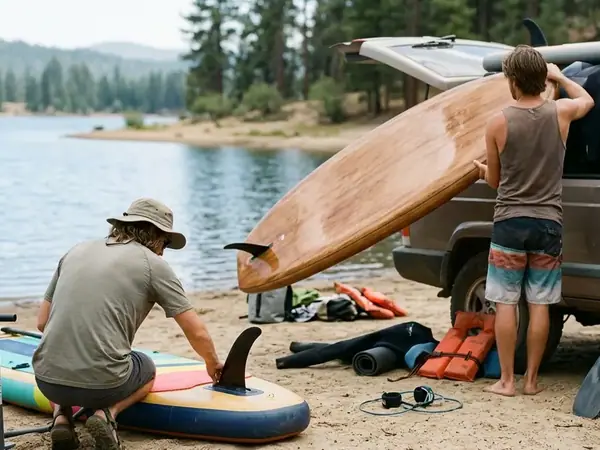
Building a launch routine around the return leg prevents wind-shadow surprises. Before unfolding an inflatable hull or unstrapping a hardboard from the roof rack, walk out to the water's edge to identify offshore exposure and verify the local forecast through the entire return window. Locate alternative downwind landings on a chart or shoreline map, and establish a strict turnaround trigger with everyone in the group. That trigger should be any unexpected difficulty maintaining shoreward progress while still close to a safe landing—never wait until the original beach is out of reach to test how hard the wind is blowing.
Next, run a physical check of worn safety gear before clipping on a single optional fishing crate or touring bag. Verify that the PFD fits snugly without riding up around the chin, confirm that the leash type and quick-release placement match the water's entanglement profile, check that the waterproof phone pouch or radio is secured on your body, test the location of your whistle, and ensure your immersion clothing matches the water temperature.
Finally, leave a detailed float plan with a reliable contact on land. State your exact launch point, intended route, departure time, expected return time, and the specific time to contact emergency authorities if you are overdue. Set trip-specific return times based on your actual daylight and weather window rather than relying on a generic waiting period. A float plan ensures someone notices if a trip goes wrong, working alongside—rather than replacing—the waterproof communication device carried on your vest. If you use a close-to-launch water check, treat it strictly as a final confirmation after conditions have already been judged suitable; never paddle out into known offshore wind just to discover your personal physical limits.
Choose a Launch That Keeps the Wind on Your Side
A well-fitted PFD, an environment-appropriate leash, and a chest-mounted radio are vital protective layers, yet they are backstops for unexpected shifts, never permission to accept an unreliable return route. Hardware cannot alter the physics of wind pushing against a high-profile hull.
Keep one rule at the front of every pre-launch briefing: assess the journey back before committing to the journey out. For any recreational paddleboard outing, when offshore wind blows across your launch and makes the return paddle uncertain, pack the board back into the vehicle and relocate to a leeward shoreline or postpone the session entirely—do not rely on harder paddling or extra accessories to bring you home.